Showing posts with label Architecture. Show all posts

Sunday, June 5, 2016

Hurry! Free entry for a few more hours: Archaeological Museum, Milan

Free entry to museums every now and then is a nice thing. Our entry fee helps to sustain their activities, but who says "no" to a thank you freebie every once in a while?
...More......

Milan's Archaeological Museum is set up on an area that used to be part of the city's ancient imperial Roman walls and circus...no kidding...that later housed the city's most prestigious female monastery, eventually overseen by none other than a Sforza abbess.

Have you been, but a long time ago? Go, again. They've renewed the exhibits quite a bit over the last few years.

Archaeological Museum of Milan
Corso Magenta, 15
http://www.comune.milano.it/wps/portal/ist/it/vivicitta/luoghicultura/Musei_Spazi_espositivi/Museo_Archeologico (in Italian)
Tues-Sun, 9:00 A.M.-5:30 P.M. (last entry, 5:00 P.M.)

Monday, April 25, 2016

Gorgeous day at the Sforza Castle in Milan

Gorgeous day...Sunday...long weekend (so feeling relatively guilt-free about not starting the preparation of the following week's lessons)...first thought? Photos at the lovely Milanese castle. Here's...More...

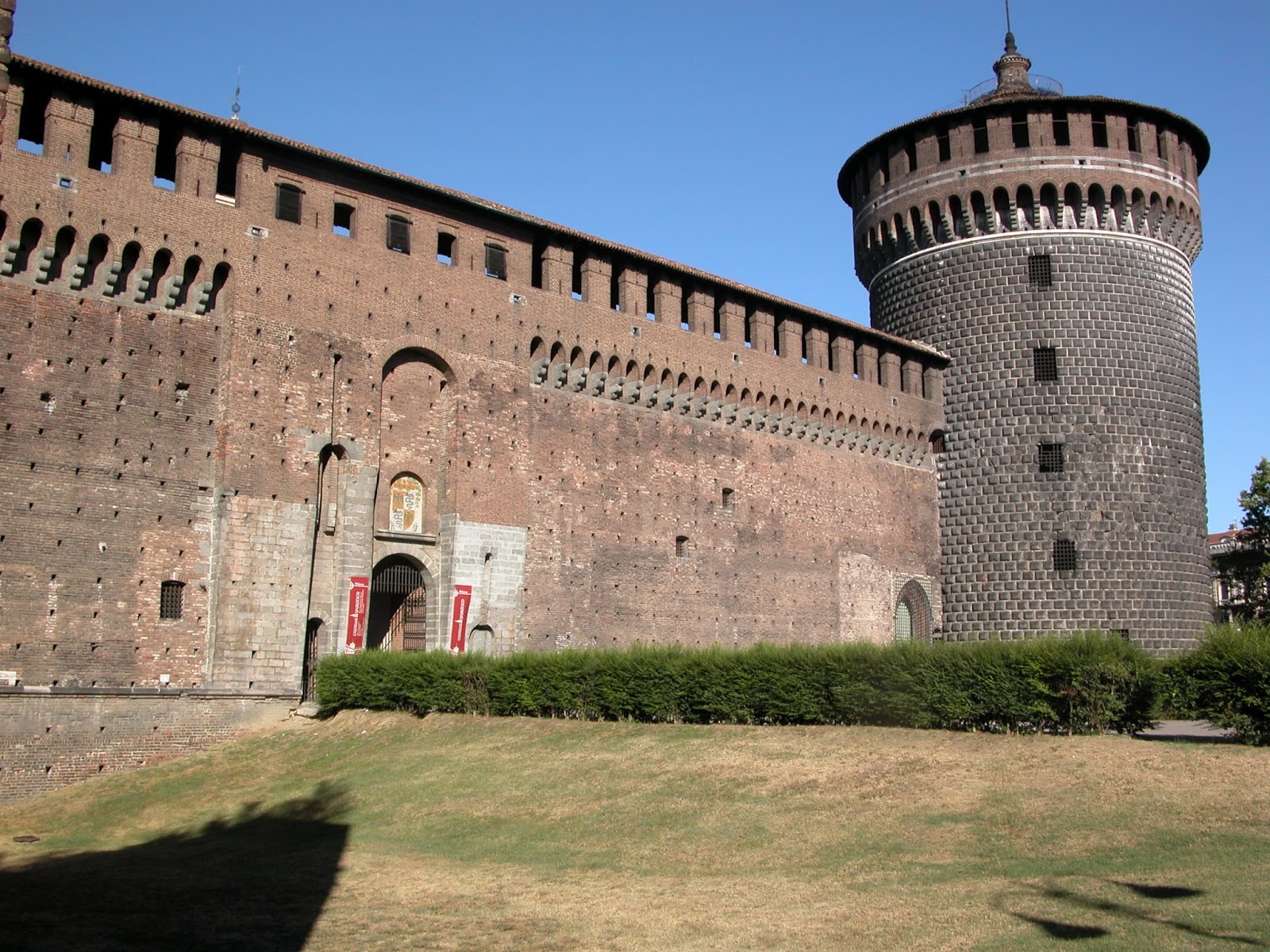
...the front façade facing toward the city.

The original kernel was a gate on the ancient Roman walls around the city, protecting the city from invasion from without.

In the Middle Ages, under the Visconti family, it was enlarged, and became a military fortress, protecting the city from without, but also serving as a last resort to protect the Visconti (who still lived in the ducal palace next to the Duomo) from the Milanese. Decidedly a change.

Having married the Visconti heiress (as a woman, unable to take political control) and being one of the time's most powerful and successful generals-for-hire, Francesca Sforza added these round (a then new development, which better deflected the then still stone cannon balls) defensive towers. If you look under the Sforza heraldic crest, you'll see that the rustication still shows damage from cannon balls. (Some of the stone cannon balls are on display in the inner moats of the castle; when cannon balls became made of iron towards the end of the 15th century -- this innovation was introduced by the invading French -- this kind of fortress was no longer able to withstand the blows, and so military architecture and defensive strategy had to change. Nevertheless, this castle, to which further defensive structures continued to be added over the centuries, was considered unconquerable...in fact, it was a traitor that let the invading French in. The story of its fate in the 19th century is for another day.)

In the 3rd quarter of the 15th century, under the Sforza family, part of it was transformed to house the princely quarters (a sign of the duke's nervousness, but also the cause of some lovely frescoes and a beautiful court in the palace area of the fortress).

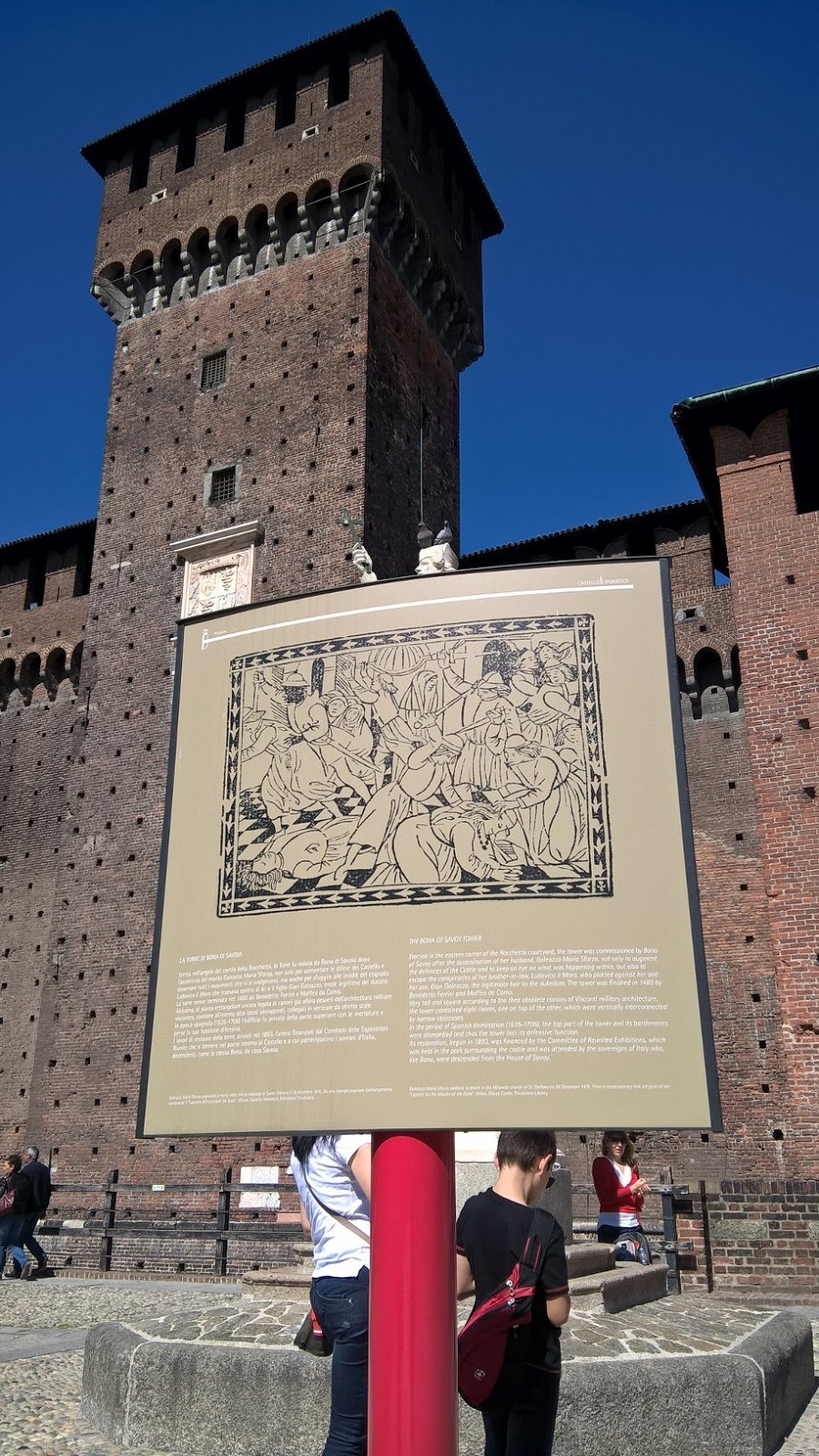
Towards the end of the 15th century after the assassination of the duke, the duchess Bona of Savoy - mother of the rightful heir, still a minor - built this defensive tower over the entrance that leads from the large military grounds inside the castle to a smaller, more easily defendable part of the castle. Didn't work. Her brother-in-law, a younger brother of the murdered duke, took over, and reigned until he, too, was dethroned, this time by the invading French.

In the meantime...those are my translations on the info panels scattered throughout the open grounds of the castle! They are still there after yea so many years. What a satisfaction.

Monday morning hugs to all,

Star

P.S., Pooh on those who say, in error, that Milan is a gray industrial city with bad weather and nothing to see!

Sunday, August 16, 2015

Villa Clerici - Gallery of Sacred Contemporary Art

Like contemporary Christian sacred art, let's say from the 1950s to now? Like early 18th century architecture and frescoes, or just nosey, and want to see how the rich and aristocratic lived in that day? You're in luck, but it will take a minimum of effort since it's a bit out of the way. Easy to get to, though, but more about the practicalities, later.

If you see this, you're not lost. The street doesn't look very promising, but it's the right one, and soon...

...More......

(Impatient type? skip to the bottom for the practicalities!)

... you'll be seeing this, Villa Clerici, built in the 1720s and 1730s for Giorgio Clerici having probably been designed by Francesco Croce, the architect responsible for the principal pinnacle (with the figure of the Madonnina) of Milan's Duomo. It was enlarged and decorated for Antonio Giorgio Clerici (1715-1768). From the 1920s, it served as a halfway house for ex-convicts to adjust to free life, and other adjacent buildings raised in the 1950s still help troubled kids. Creating a museum of sacred art by inserting modern and contemporary pieces into this historic context was the 1950s brainchild of Dandolo Bellini.

The grand salon, redone complete with mirrors in the 19th century, is still beautifully decorated in 17th century style, and has a large 1968 bronze sculpture of "a pope" by Floriano Bodini.

It looks like Paul VI, a personal friend of the founder, and is a bit disquieting and ominous with those boring eyes and, bursting out of the gap in his cope, those enormous rubbery hands and a dove. Catholics the world over please forgive me, but it looks like a threateningly enormous deranged cuckoo clock.

Some of the pieces are interesting in and of themselves for their references to famous sacred figures, to Biblical figures and narratives, for having been done by well-known artists, for the possibility to study them up close and personal, for their intriguing nature, or for the possibility of comparing them in your mind to more famous pieces (like this "Pietà" by Attilio Selva that screams out references to Michelangelo's "Rondanini Pietà," in Milan since the 1950s,...

...or the little "David" by Francesco Messina contrasted with the Renaissance ones by Donatello and Verrocchio).

There's even an installation, which I liked -- a lot -- the moment I set eyes on it: "Christus Patiens" (Suffering Christ) by Claudio Bonomi. The rich colors are not only pleasing, but they also evoke the purple vestments and hangings that are used for mourning in Catholic churches, while the reclining figure of Christ, coming, it seems to me, from a Deposition, seems to float on the mystical lap of Mary, and it's possible to observe the iconographical suffering caused by the wound in Christ's side together with the physical suffering of the sculpture, itself, damaged, exposing the inner structure of the broken hand.

Other objects are interesting because, as sketches, they give you a backstage glance at what the artist was trying to achieve. (Often, the painted or sculpted sketch, freer in execution, is much more lively and engaging than the final product.) There are quite a few large original colored drawings done by the artist Aldo Carpi, responsible also for some of the modern stained glass windows in the Duomo. It's interesting to see how the artist skillfully kept the technicalities of producing stained glass in mind as he designed where to put the struts and the canes (these latter being the "H"-shaped bars into which the glass pieces are fit).

Over the grand entryway is a lovely room with fictive sculptures of female figures, perhaps the muses or at least learning and the arts (I saw an artist and a writer, for example). Don't try going through the door on your left...it's fake. Symmetry is everything. Do note, though, that the shadows cast by the 'sculptures' were planned keeping the natural light entering from the windows on our right in mind. Very clever, but not new in the history of art.

Some of the ceilings are still quite pretty.

The front and back gardens were put in by Mr. Bellini to replace the lost original ones, but they, too, were most probably in the Italian style, that is, geometrically laid out, as opposed to the English style favoring a seemingly natural, though really carefully planned, environment. Behind the villa is a large theatrical setting that would make open air theater a joy...if one could stand the heat and mosquitoes.


Admittedly, the museum is a bit old and dusty in its layout, but real museum and art fans won't let that bother them. It also was as hot as Hades the day I went, and the lack of summertime AC means that there are a lot of enormous jumps in temps and humidity levels that are dangerous for the building's decor and many of the more delicate art pieces. It was my first time there, so I can't say if it is heated in the winter, but I can say that -- as is typical of, I'd wager, most Italian public places, including museums -- it isn't handicapped accessible. No bar, not even a vending machine (though they might be considering such, given the items on the questionnaire), but the bathrooms are clean, and it's pretty easy to get to, though it does take a gouge out of your day.

So, is it worth it to go? Yes, if you are interested in 18th century villas and/or modern and contemporary art, sacred or not.

If you live in, or near, the area, they apparently have a lively music and conference program throughout the year, too.


VILLA CLERICI - GASC / GALLERIA DI ARTE SACRA CONTEMPORANEA

Via Terrugia 8/14

02.647.0066 / 02.6611.8036

Hours: Monday - Saturday from 2:30 to 18:30 PM, no reservations required

Entry fee: E 2.50


HOW TO GET THERE

Get yourself to the via Terruggia stop in "downtown Niguarda" (Niguarda being a peripheral area absorbed by the expansion of Milan, it still has quite a provincial small town feel to it, despite the large and famous "Novecento" style hospital.) From downtown, it might take about 45 minutes.

To do this, you can take the MM3 / yellow line to Macciachini, then the n.4 tram to NIGUARDA CENTRO (NOT Niguarda Ospedale), get off, and walk in the same direction you just came for about three streets, then turn left onto Terruggia.

You can also take the MM5 / lilac line to Ca'Granda (another name for the hospital, which substituted the Renaissance hospital of that same name, whose buildings now serve as the main seat for the State University of Milan), where you need to take the bus n. 42, and get off at the via Terruggia stop.

Alternatively, you can take the MM5 / lilac line to Bicocca, then take the 52 bus to the stop via Terruggia / via Val di Ledro.


Enjoy!

Tuesday, June 2, 2015

It's June 2...what to do in Milan?!

It's going to be a nice day, come on!, get up off the couch and out into the fresh air!

Milan's beautiful late...More......

...Renaissance city hall, Palazzo Marino, once a private mansion that broke the mighty coffer of its builder, offers rooms newly open to the public. From 10 A.M. to 8 P.M., it will be possible to go (you might have to stand in line, let the visitor beware). Where? Piazza della Scala.

The line for the mansion looks a bit too long? Then try the one for the mid to late 19th century multi-use complex (and you thought malls were inventions of our own day! Heck, there were already shopping streets with covered porticoes as far back at least as the ancient Roman empire...even in Milan!), the Galleria Vittorio Emanuele. Very recently, the upper catwalks have been opened to the general public. The entrance is at via Silvio Pellico 6 on the other side of the Galleria from the Piazza della Scala. Hours? From 10 A.M. 'til 6 P.M., groups of 25 will leave on the half hour.

These visits, though not with these hours, will continue to be available. Stay tuned!

What could be a better way to spend time with the family: beauty, history and (hopefully!) good company, all rolled up into one!

Enjoy! And Happy Birthday, Italy!

Monday, April 6, 2015

Massive amount of additions to my "Art in Milan" pages on the "Where Milan" site...check 'em out!

In honor of Expo, I've finally got the better of distractions, and spent HOURS writing out quick summaries for almost all of Milan's principal museums (and there are quite a few). Still have a couple to go, but am pooped. Will finish tomorrow. In the meantime, here's link, so you can have that info on hand, too.

Enjoy!

Sunday, February 8, 2015

Milan tourist card options and a couple of principal info sites

Before you leave for Italy, you might want to surf the tourist card sites offering discounts to see which one is best for you (often museum, restaurant and public trasportation discounts are offered, and there just might also be free tickets for the special bus between Malpensa and Milan...the latter is not quite half the cost of the train, but even that--at about E.13.00 one way is reasonable, and the tickets can be bought at the airport). Various options for various time periods are available at various prices, so compare to find the best fit for you.

A word to the wise:...More......

...if you want to see Leonardo da Vinci's Last Supper, be sure to look for that as part of the package. Tickets have to be bought weeks, even months, in advance, and go like hot cakes.

Another word to the wise: avoid coming to Milan when there are trade fairs in town. That fills up hotels, and pushes up prices. How to know? Go to the official web site, in English, and look at the calendar for your desired dates. The principal trade fairs to avoid are women's and men's clothing, and the furniture and design fairs.


MILAN PASS (together with Zani Viaggi, who also do bus trips to outlet malls)
I like this one because it includes the Hop On-Hop Off City Sightseeing bus (covered and open) so you can get a better idea quickly of what there is in the city, how far things are from each other, and then decide. Zani Viaggi is also an authorized retailer of official Expo tickets. The web site is available in 80+ languages; if it doesn't open in English, use the pulldown menu in the upper right hand corner.


MILANO CARD
The offerings seem to be pretty broadly packaged, including options for the Lombard lakes region (don't miss beautiful Como, if you can help it), Rome, Florence and Venice. Go here.


AMA MI
Perhaps the first city card to come out, it seems to have disappeared. I can't find any updated info on it.


CITY DISCOVERY
Not quite a "pass," it does offer, among other things, a three-hour walking tour that includes Leonardo da Vinci's Last Supper. Go here.


LEONARDO DA VINCI'S LAST SUPPER
Want to do everything on your own? Buy your official Last Supper tickets, here, through VivaTicket.


EXPO
More do-it-yourself help? Here's the official Expo web site in English.


ENIT
Italy's official tourism info source...though it doesn't get the support that it should (and a coordinated effort has faded with the abolition of the Ministry of Tourism...in Italy, for Pete's sake...in the early '90s). The site and offices still might be helpful. The site has a map on which you can find their office nearest you (if it's still open...).


VISITA MILANO
The official tourism site of the province of Milan (of which the city of Milan is the capital), this web site is full of great info, especially if you're interested in getting off the beaten track, and getting outside of the metropolis.


MILAN IS TOURISM
The city of Milan's official page, it, too, is FULL of info (including for specialized interests and sectors). You'll have to arm yourself with patience and a magnifying glass. Despite complaints, they have kept the black background... I guess they think it's cool, but it's quite hard to consult, the reading is difficult. The web site address to take you directly to the English version is absurdly long. Go here, and click on the English flag button. You'll get there all the same. You can buy your Expo tickets, here, download free apps with tourist info, and a whole bunch of other stuff.


OFFICIAL MILANO TOURISM OFFICES ("POINTS")
The name has changed a few times, but the idea is the same: to give up-to-date and accurate tourism information. Group tours, whether general or specialized sometimes are offered (for example, a tour of the art nouveau ["Stile Liberty"] architecture in town, or of ancient Roman Milan). Go here to find their info points.


TOUR GUIDES
Want a tour of the city? If you want a private tour of the city, there are lots of tour guide associations and private guides whose information is available on the internet. BE FOREWARNED: to be a tour guide in Italy and Europe, it is obligatory to have passed an exam, and to have received a license to operate. This is supposed to help guarantee an acceptable level of service and English, which is obligatory (other languages are available). There are too many to list, here, so here's a link to the oldest association.


And, last, but not least:


MY MILAN (ITALY) and ART IN MILAN (Where Milan)
Don't forget to surf my blog, "My Milan (Italy)" open since 2010, and my "Art in Milan" (active on Where Milan since 2014) for more great stuff! Come back, and check for new posts!


Enjoy!

Tuesday, February 3, 2015

Feel like being nosey in a homey environment? I've just the thing for you: the Circuit of Historic House Museums

You’ve come to/live in Milan, and already have visited everything in my previous post, well, OK, lots of things in my previous posts.

So, now what?

I’ve just the thing!

The Circuit of Historic Houses in Milan will give you a chance to enjoy three out of the four still hidden gems of Milan, as well as one of its best known museums, so let’s go.

Let’s start at the Bagatti Valsecchi Museum, where you can buy the Circuit of Historic House Museums card. The card is valid for a year for all four museums, and it costs less than buying the individual entry tickets. For general information in English about the card and...More...

...the circuit, go here.


BAGATTI VALSECCHI MUSEUM

The best place to start is with the Bagatti Valsecchi Museum, and not just because I work there, so I’m partial--I admit it!--but also, objectively speaking, because it’s a time capsule back into a late 19th century aristocratic Milanese home filled with the original collections of Italian Renaissance art and decorative arts, all placed just where the collectors originally wanted the things to be seen. This way, you’ll get a good idea of what traditional Milan was like at the end of the 19th century before you rush to see anything modern … believe me (and this is the art historian in me speaking), you’ll understand "modern" better (and maybe even like it more), if you understand "traditional," first.

Cross the threshold and let the thoughts of Fausto and Giuseppe Bagatti Valsecchi accompany you, as you enjoy 15th and 16th century paintings, sculptures and furniture, and imagine the brothers sitting like lordly Renaissance princes in front of crackling fireplaces decorated with early 16th century frescoes. Laugh with the brothers at their sense of humor and, why not?, be a little envious of their good luck to find a Giovanni Bellini, a Giampietrino (one of Leonardo da Vinci’s favorite pupils), a few Zenales, works by other respected artists and a much revered portrait from the workshop of Gentile Bellini, as well as gorgeous majolica, glass, arms, armor, a couple of Rodari sculptures and a beautiful Madonna in Donatello’s "schiacciato" style.

Wander at your own pace. The use of the very good (if I do say so, myself...I helped to write them) audioguides is free of charge with entrance ticket purchase; they are available in English, French and Japanese, as well as Italian. Information cards in English, French, German, Spanish, Japanese, and soon Chinese and Russian are in each room. Guided visits in many be reserved in various languages. The sumptuous rooms of the museum also are available after closing hours for special events.

The Bagatti Valsecchi Museum, together with the other historic house museums, is a great museum to visit, even for people who don’t usually like to go to museums.

Why?

Because, since it’s a house, it’s homey, and you can go through it looking for your favorite kind of object, be it majolica, arms & armor, glass, glass, scientific instruments, musical instruments, clocks and whatnots, besides the paintings and sculptures...or...you can just be nosy, and peek around to see how the people lived.

If you, or someone you know, lives in Milan, don’t forget to sign up to the Bagatti Valsecchi Museum newsletter, available in English, on the web site. It will keep you informed of the museum’s temporary exhibits, concerts, conferences and kids activities.

Remember to buy the Circuit of Historic House Museums of Milan card, here, because it’s cheaper in the end, and lasts a year!

One more thing: the restaurant on the ground floor of the Bagatti Valsecchi mansion (NOT the same management as the Bagatti Valsecchi Museum) is a completely separate entity, so I don’t have any official information for you about it, but I often see people, there, so you might give it a try.

BAGATTI VALSECCHI MUSEUM
Via Gesù 5 (a few minutes walk from the Duomo, La Scala and San Babila)
MM1-San Babila, MM3-Montenapoleone, Tram 1-Montenapoleone
Handicap access available upon request
Tel. +39-02.7600.6132 (HINT: when making calls within the same city in Italy, it still is necessary to add the city code, in this case, 02)
http://www.museobagattivalsecchi.org
https://www.facebook.com/museo.valsecchi


Next house on the circuit to visit is:

VILLA NECCHI-CAMPIGLIO

A 10-15 minute walk from the Bagatti Valsecchi Museum is the Necchi-Campiglio villa, yes, a countryside style villa in the heart of Milan. Why next on the visit? Because (1) it’s your next step closer to the present in time, and (2) it’s a step toward social change in Italy: from the Bagatti Valsecchi aristocratic mansion to the villa of wealthy, but upper middle-class industrialists. The villa was built in the 1930s and 1940s by one of Italy’s most famous modern architects, Portaluppi (though some of the interior was "updated"--much to my personal chagrin--in the 1950s). Portaluppi’s sun room is my absolute favorite room in the whole house, well, that and the small (by today’s rich standards), but stupendous master bathroom. Set in its own walled garden, the house built for the heirs of the Necchi sewing machine heirs, Gigina and Nedda, and Gigina’s husband, is restful, and has a separately operated caffè.

The house, a FAI-Fondo Ambiente Italiano property, was chosen to house an art collection of the same years, but assembled by a different person. Although not original to the house, it fits in very well.

I have to admit, though, the museum has one serious drawback. You can’t wander at will. You’re obliged to reserve and follow a guided tour of the museum, so you can’t linger and enjoy as you might like. On the other hand, it’s one way to keep you off the furniture!

I’m pretty sure that they have tours in English, but it’s better to check out their web site, and write them an e-mail.

VILLA NECCHI CAMPIGLIO
Via Mozart, 14
T +39-02-7634-0121
http://eng.fondoambiente.it/beni/villa-necchi-campiglio-fai-properties.asp


The next step closer to us in time is the Boschi-Di Stefano Museum.

BOSCHI-DI STEFANO MUSEUM

OK, so, even without the Circuit of Historic Houses of Milan ticket, you could have gotten in for free in this city-owned museum, but the others, no, so go ahead and buy it, it’s still cheaper than buying the three other tickets, separately.

What’s so special about this museum on an upper floor of a nice, but normal condo building? First of all, it takes us one step closer to our own day, stretching from the 1930s up to the 1970s, but it also moves us from upper middle class to the solidly middle class circles. Antonio Boschi was a talented engineer working for the Pirelli company, his wife, Marieda Di Stefano, inherited her family’s interest in art. An artist, herself, she and her husband were passionate about then contemporary art, and so the collection has pieces from their entire married life, all displayed, crammed really, onto the walls of their fairly small condo. Pieces by Milanese artists, or artists working in Milan, were particularly collected, and so that includes the pieces by artists of the world-famous Futurist movement.

It is possible to enjoy the collection on your own, and the website is in English, but if you’re in a group of more than a few people, you’ll need to make reservations ahead of time (that’s normal, though, with pretty much all museums, world-wide).

BOSCHI-DI STEFANO MUSEUM
Via Jan, 15
T +39-02-2024-0568
http://www.fondazioneboschidistefano.it/ws/en/


Finally, we come to the Grand Old Dame, the last museum on the circuit (at least as of the writing of this post): the Poldi Pezzoli Museum.


POLDI PEZZOLI MUSEUM

Once fully a historic house museum, if the truth be told, this (really lovely and rightfully famous) museum really is no longer a historic house museum, in my opinion. Directly bombed during World War II, almost all of the original interiors were destroyed. What remains: the spiral staircase, the small room with the Meissen porcelain and the Algardi sculpture, the Black Room (well, mostly), and (well, mostly) Poldi Pezzoli’s Byzantine-inspired study.

Giuseppe Poldi Pezzoli was the son of two noble families, his mother was a Trivulzio. As a young adult he actively participated in Milan’s first (unsuccessful) bid for political freedom from the Austro-Hungarian empire in 1848...for which he was exiled for a few years to encourage him to cool off. He took advantage of the forced time away from Milan, and travelled throughout Europe, becoming a passionate collector of art, which he installed in his house, as decoration for himself and—though he confided it only to his lawyer—as a museum for after his death (he died unmarried and without children, so just imagine the surprise of his cousins when the will was opened).

Much of the collections was taken out of Milan during WWII, so it was saved, but, except for the above-mentioned rooms, was installed in the refurbished spaces in the typical set-up of a museum, the principal reason why I don’t think it still can be called a historic house museum, as wonderful as the collections are. Furthermore, Poldi Pezzoli had specified in his will that the museum’s collections should continue to grow and change, and so the museum has been able to acquire lovely pieces, or receive them as donations, that never were part of the original collection.

Whether you do the whole circuit of historic houses, or not, and I hope you do, this museum--with some famous masterpieces and many other works by famous and not-so-famous artists--is well worth the visit.

POLDI PEZZOLI MUSEUM
Via Manzoni, 15
T +39-02-794-889 (yes, the number has only 6 digits…it’s an indication of the age of the phone number; some numbers in Italy even have only 4 digits!)
http://www.museopoldipezzoli.it/#!/en/discover/ (I have to say that I REALLY dislike their website; it’s much too modern, doesn’t evoke the nature of their collections, and is so fragmented, I can’t find stuff easily, but they didn’t ask me, when they planned it, did they?!)


There, a lovely day of charming homey visits to some hidden gems and the Grand Old Dame of Milan, all chronologically arranged so that they make more sense. Did you notice that they're all art and architecture patrons and collectors' houses?

I hope you enjoyed yourself, and that you tell family and friends!

(And don’t forget to visit the Bagatti Valsecchi Museum...but you knew I’d say that, didn’t you?!)

Monday, December 1, 2014

48 hours to visit Milan?

48 hours to visit Milan?

Here are my suggestions for two food- and fun-packed days, especially for a first-time trip to the city.

See my "48 hours for your first time in Milan" post for my "Art in Milan" column on the excellent "Where - Milan" web site.

It was so time-consuming to compile and illustrate, you'll probably have time to come and go before I manage to do a second or third one. :-)

(Photo: my snap of Palazzo Belgioioso in Piazza Belgioioso, Milan)

Monday, May 26, 2014

45 floors and counting... City Life

The first of the three tall towers planned for City Life in the area once occupied by the in-town convention and trade fair center (bits of which are still left, don't worry!) has reached 45 floors and counting.

I snapped this shot today at about 9 AM just for your personal non-commercial enjoyment. Aren't I nice?

(Now, if they would just put an official ground plan on their web site, we'd all be happy...)

Wednesday, May 21, 2014

Open Courtyards (Cortili Aperti) in Milan, Sunday, May 25

Milan is like a discreet lady, often luxuriously gorgeous behind a simple veil.

Want a chance to go nosing around some of these courtyards? You're in luck!...More......

Sunday, May 25, is the annual "Open Courtyards" (Cortili Aperti) day organized by ADSI, the association of historic Italian homes NOT to be confused with historic house museums. The homes belonging to this association still can be private dwellings, or can have been transformed into B&Bs or hotels.

In Milan, here are the places you can visit (no reservation necessary):

- Casa Sioli – Legnani – via Borgonuovo 5
- Palazzo Orsini di Roma – via Borgonuovo 11
- Casa Recalcati – Taglisacchi – via Borgonuovo 15
- Casa Bigli Samoyloff Besozzi – via Borgonuovo 20
- Palazzo Moriggia – via Borgonuovo 23
- Casa Valerio – via Borgonuovo 24
- Palazzo Landriani – via Borgonuovo 25
- Palazzo di Brera – via Brera 28
- Orto Botanico di Brera – via Fiori Oscuri 4
- Casa Ajroldi - via Fiori Oscuri 13

In some courtyards, you will be treated to music thanks to a collaboration with the Civica Scuola di Musica.

In others, you'll be able to look at historic cars thanks to a collaboration with CMAE, the Milanese club for historic vehicles.

The InfoPoint is in Palazzo Moriggia, seat of the Museo del Risorgimento (via Borgonuovo 23). There are guided tours throughout the day, but they'll be in Italian, and you have to sign up by 7 P.M. on Saturday the 24th. Adults 18 and over pay Euro 10 once there (the price includes the use of the headset...but from previous experience, if you're a little picky about putting things on your ears that have not been sterilized, I'd bring some disinfectant, if I were you), anyone under 18 attends for free. Just in case you want to brave it:

E-mail: info@cittanascostamilano.it
Tel: 347 3661174

I snapped this shot in Via Amedei on the 23rd of December, 2011, at almost 3 P.M.

Enjoy!

Monday, December 16, 2013

Neo-Futurist fun in Milan

Running around Milan for last minute holiday gifts?

Look up, now and then!

An expected delight on the corner of Corso Magenta and via Carducci just a hop, skip and jump from the Cadorna train station: Rino Ferrini’s 1936 timidly Expressionistic and Neo-Futuristic building…apartments above, shops below.

I snapped this photo on the 17th of November, 2013, at about 5:30 P.M.

Enjoy!

Friday, November 15, 2013

Cova...a very nice pun

So, here I am "cova-ing" ("covare": incubate, nurse, sit) a few new projects that are keeping me hop-hop-hopping, but missin' ya', so here's my lovely snap of the...More...


...mansion built in 1910 by the architect Adolfo Coppedè for the Cova family on a corner just in front of the piazza and reconstructed gate in front of the (marvelous) Sant'Ambrogio church...very very ancient, indeed, and worthy of its own post...some day....

The "Touring Club - Milano," my usual source for names and dates, doesn't specify that the Cova family was one and the same with the family owning and operating (at least, then!) the lovely and historic Cova bar and pastry shop in the Montenapoleone district...but what other Cova's could it have been?

Gotta run, but sending hugs, and hope to be able to write more, soon!

Enjoy!

Friday, August 16, 2013

The Natural History Museum of Milan...thanks, ENI

Dear You,

ENI has been so kind as to offer you free entrance to Milan's civic museums this summer. Have you gone, yet?

Next one on our list is...More......

...the Natural History Museum in the Porta Venezia public park, at the corner of Corso di Porta Venezia and via Palestro.

Outside, the building retains its late 19th century style,...

...inside Rationalism makes the hall and stairwell a light-filled and clean-lined delight.

There are collections of all kinds: minerals, mankind, bugs and...

...animals big and small in new dioramas...

...and the kind of old-fashioned cases that I remember from my childhood...

...and fascinating tidbits, such as the creatures from which the different kinds of scarlet--and their appraised qualities--come from. For the portrait of a cardinal, they have reproduced a painting by Raphael, without any credits, naughty naughty!

Dinosaurs and fossils, of course!

The museum is fairly kid-friendly...what kid doesn't love dinosaurs?!...but there also are a few displays for them, with the help of accompanying adults.

Tired and thirsty? There's a cafè upstairs, and it's handicap accessible (as the museum is...with a bit of difficulty and sending someone upstairs to get the little wheelchair lift going...if it works...). Don't wait too long, though. It closes shortly after the museum.

Right now, some rooms are closed; they're being set up for the popular traveling* "Brain" exhibit that will open in the fall. (*American English doesn't double the "l"...)

Their website isn't in English...goodness, but they'd better get on the ball in time for Expo. Here's a bit of info to help you get started: Tues.-Sun., 9 A.M. - 5:30 P.M. (last entry, 5 P.M.), closing days: all Mondays and Jan. 1, May 1, Dec. 25. For more info: +39 02 88463280.

Entry costs are reasonable (or free, for certain typical categories), but the surprise is that anyone entering the museum from 2 P.M. on a FRIDAY, or during the last hour of any day the museum is open (i.e., from 4:30 P.M.)...gets in FREE!.

Enjoy!

Sunday, August 11, 2013

Museum of Ancient Art--the title misleads, the collection delights

Today's turn? The "Museum of Ancient Art"...More......

So, thanks to Eni's "Arte aperta" sponsorship of Milan's civic museums' entrance fees, we've seen the Archaeological Museum, and we've touched on the Acquarium, the Novecento Museum, and the Egyptian, Celtic and historic musical instruments collections in the Sforza Castle (the goldsmith, ceramics and ivory collections were closed that day for lack of funding for personnel, but if they are open when you go, they are worth a look).

I thought I had done a review of the Risorgimento Museum, already, but can't find it--have lots of pictures, just have to find them!--ditto for GAM-Gallerina of Modern Art (i.e., 19th century prior to modernism...it wasn't the best title choice), the Museum of Milan in Palazzo Morando (also revisited the other day) and the Natural History Museum, so those reviews hopefully will be coming, soon. Today, it's the turn of the equally misleadingly entitled "Ancient Art" Museum in the Sforza Castle, which concentrates principally on the arts of Milan from its beginnings up to the eve of the modern period.

Just about where the front gate of the castle is, that's where the ancient Roman walls passed, and the gate dedicated to Jove was.

The medieval military fort was built a bit farther out, aligned with the slightly larger circle of walls built to repulse Frederick Redbeard of Hohenstaufen, the Holy Roman Emperor as intent on the submission of the Milanese as they were to retain a bigger say in their daily affairs. The gate was just about where this one is, today. (The tower was added during a turbulent period in the late 15th century, after the dukes of Milan had moved their official residence from the palace next to the Duomo to the military fort, turning a part of it into a princely palace...some of whose goodies we'll be seeing, soon!)

Don't miss looking down into what was the moat--part of Milan's canal system--where you can see the stone cannon balls fired--probably by the French at the end of the 15th century--and the castle's cats. Go through this gate, and after passing through, turn immediately to the right.

The entrance hall, revamped a few years ago, has the gift shop, too. Toilets down below--prosaic, but helpful, info. If the handicapped elevator is working, it's here, too. The stairs head up to the goldsmith, musical instruments and ceramics collections. The Arch of the Ironworkers--one of the real arches from Milan's medieval walls--is the marker between our banal everyday world and the sublime of the "Ancient Art" museum.

Heaven starts with a few lovely ancient Roman bits and pieces (that man is blithely walking on an ancient Roman-Milanese mosaic!), and races too quickly through Milan's Longobard phase (why didn't I take any photos this time?...if I find one in my stock, I'll insert it, later) and...

...its Byzantine phase...here's the sculpted head reputedly portraying Theodora, Justinian's Empress. It's a good shot, too, of the exhibit layout by the famous architectural studio BBPR for the most part still lovely and effective, today (except for the set-up for Michelangelo's Rondanini Pietà, a child of its times, setting the work apart as the fruit of a genius, precluding instructive comparisons with almost contemporary sculpture in French Milan that still breathes a Gothic air; the Pietà's display is slated for change).

A couple of rooms dedicated to medieval sculpture from Romanesque to the late medieval periods delights with sculptures, such as this 12th century dragon, and...

...the imposing equestrian tomb monument for that ol' rascal Bernabò Visconti, originally intended for under the crossing in his palace grounds church, San Giovanni in Conca (official web page available only in Italian), in today's Piazza Missori area (in that period, the government of Milan was shared between Bernabò and his brother, who lived in the other half of town), and the more Renaissance-inspired monument on columns for his wife Beatrice Regina of Verona's ruling La Scala family (we've mentioned her in previous messages)...the sarcophagus you see on the right, intended for the crypt of the same church, directly aligned with her husband's monument. The ceiling is lovely, but dates to the 16th century, the first decades of the (very long) Spanish occupation.

The ceiling in the next space, the Ascension of Christ, dates, instead, to the 15th century, and seems to indicate the space where the castle's first chapel was.

This couple of rooms also offers the fascinating possibility to see the mid 14th century sculptures by Giovanni di Balduccio once on Milan's medieval gates (only two of which survive, today),...

...the fragments and the giant print showing the façade of Santa Maria di Brera, mentioned in my post about the Pinacoteca di Brera, and...

...the spectacle of an almost complete Gothic tomb (the effigy--or reclining portrait sculpture--is missing). Just think, Italian Catholic churches were filled with these medieval beauties until that party-pooper St. Charles Borromeo appeared on the scene in the mid-16th century...he was important in the Catholic Reformation, and had as many taken down as he could manage because he thought them distracting. O.K., they were. They focused attention on the wealth and importance of the defunct, but they also were testimonies to hope.

A small room divides two larger ones, and too often is overlooked. The 14th century sculpture of Christ on the Cross (there are others upstairs) is relatively rare due to the delicate nature of the wooden material. If you look closely, Christ looks like he's taken to shaving his head...but the sculpture probably had a real hair wig.

The next room has some of the most fun things in the whole museum. As well as gorgeous, of course. Here, the two upper friezes of the Porta Romana gate of the medieval walls celebrating St. Ambrose's throwing the Arians (one of the kinds of Christianity popular until what we know as Catholicism began to win about four to five centuries after Christ's death) out of Milan...just like the Milanese had tossed out...

...Frederick Redbeard Hohenstaufen the Holy Roman Emperor also depicted on the town's gates seated elegantly crossing his legs...over a devil..., and...

...on Porta Tusa (pronounced "TOO-zah," Gate of the Girl) a woman cutting the hair off of her pubis--as prostitutes did--presumably a reference to his wife. "You're a devil, and your wife's a..." If you're going to insult someone, you'd might as well go whole hog.

The next room has tapestries (ho-hum...sorry!) and this gigantic embroidered and appliqued banner designed by Meda (who also drew up the plans for Milan's Darsena, or in-city harbor) with Milan's patron saint, Ambrose; it was carried by lots of men (darn heavy) in processions.

Be sure to peek through the windows at the "bridge," a series of rooms and a covered portico reportedly designed by Bramante for Ludovico il Moro to get a bit of fresh air while in the castle.

The next room will knock your socks off...or it should. It was Ludovico il Moro's throne room, and was decorated with a bower, landscapes and architectural ruins by Leonardo da Vinci (though it's not clear if it had been finished, completely, before the French tossed the Sforza out). The room is being restored.

The next room's frescoed ceiling is gorgeous, too: the Sforza ducal crests.

In this room, we first begin to enter the Florentine-inspired Renaissance in the Milanese dukedom. Here's a putto from Castiglione Olona, about an hour and a half away...by car...on the freeway. The Gothic-inspired tradition will continue alongside the Florentine-inspired Renaissance, and the two will share characteristics in Milan, examples can be found in this room. Go, and see for yourself!

The next room also has a lovely frescoed ceiling (red with a golden flying dove pattern in imitation of a tent) and more precious Milanese Renaissance era sculpture.

From it, you can step into my favorite room in the museum...even if they have ruined it...

...by installing a stand for an admittedly lovely painting of the period. The room was the new (late 15th century) chapel of the princely palace. The frescoes are a wonderful example of this blending of courtly Gothic and Florentine- and Padua-inspired Renaissance. The former are represented by the heavy use of gold gilding,...

...while the latter are easy to see in the classicizing motifs of the Resurrection and Ascension of Christ.

Interested in fashion? Look again at the preceding photo with the standing sculpture of a woman...it turns out to be the late 15th century adoring Madonna del coazzione, or "Madonna with the long special pony-tail." The "coazzione" was a very very long (often bound) pony-tail stretching down to the woman's calves.

Even the rich brocade of her gown is rendered.

The subsequent long gallery offers lots of fun for the guys...and gals: arms and armor of the centuries past, as well as Renaissance portals and reliefs coming from buildings in town.

Next comes the room with the enigma of the BBPR display of...

...Michelangelo's Pietà purchased in the 1950s, and put behind a gigantic wooden room divider,...

...separating it from this almost contemporary, yet thoroughly old-fashioned, effigy of the French king's nephew, a brave commander who fell in battle at a young age.


Exiting you pass a precious source of water (especially during a siege!) in the shape of the decoration on a warrior's helmet, or maybe a chess piece...or both!

Exiting, turn left twice, and go up the (long and shallow for horses in the absence of elevators!) steps to see the decorative arts and eventually the painting collections, for which one example each is going to have to suffice.

This sleeping putto is from 17th century Germany. It tops a coffer, or little precious box.

O.K., I said one, but I couldn't resist. Here's a 16th and 17th century automaton that probably scared the heck out of its observers. Nevertheless, each time I see it, the creature's well-modelled and beautiful bust, shoulders and arms remind me of the representations by Sodoma and by Bramante (the latter at the Pinacoteca di Brera) of Christ being whipped at the column.

This detail of d'Oggiono's wedding feast at Cana will show you how artists were LOOKING at their surroundings. The sleeve is bicolor because the fabric is cangeante, changeable in color (a factor depending on the way two colors of threads are woven together).

Leaving by the eastern gate reminds me to point out two things to you: (1) look at the newer, fresher appearance of the brick in the crenellated area...those have been restored, and (2) (paid) guided tours of them are available...probably only in Italian, but check here, and call, just in case.

I do so hate to leave you after having so much fun together, so as my good-bye present here's an extra snap that takes in one of the ruins of the larger complex defensive structures and walls that ranged around the castle and the castle, itself. I hope you've had fun, too, and been stimulated to visit the Sforza Castle and its collections for yourself.

Enjoy!
Related Posts Plugin for WordPress, Blogger...