Showing posts with label Musings. Show all posts
Wednesday, December 12, 2012
12-12-12 & gratitude
12 things for which I'm profoundly grateful:...More...
1) 15 marvelous unforgetable spiritually enriching years with my dear sweet Mario, whose death in 2010 unleashed a broad, deep, swift-flowing, icy, subterranean river slowly being bridged with the help of...
2) ...dear family
3) ...dear and inspiring friends among whom I count my co-workers and students
4) ...and work & studies...
5) ...that I love;
6) utilities
7) a home with a clean bed and a full fridge
8) efficient public transportation
9) health
10) reading
11) computers
12) internet
How 'bout you?
Enjoy!
(Image: my handsome Meyer grandparents in about the 1930s...thank you for the picture, Uncle Pete and Aunt Darlene!)
Friday, November 2, 2012
Remembering...
Today is a bittersweet day, the day we focus on remembering our dearly departed (as if they were ever out of our thoughts for even a moment, as if they weren't present with us, inside our hearts, our brains, our beings every moment, waking and sleeping, of every day...)....More......
My dear Mario was an amazing man.
Smart, caring, funny, warm, thoughtful, firm in his convictions, but open to honest dialogue and change, able to relate sincerely to popes, princes and paper boys.
He also made an enormous contribution to medicine in Milan, in Italy and in the whole world: he founded and chaired the world's first university chair for the physiopathology and therapy of pain, for which he was inducted into honorary membership (a "hall of fame") in the most important international association of pain specialists, IASP. This, for him, was his most prized award, rather, he used to say, like the Nobel prize in applied medicine (Nobel established a prize for researchers, not for doctors working with patients).
Then, among the gazillion other awards he received, his other most prized award he received in 2007: the Galen award for excellence throughout his medical and university career. He was the first to receive it.
Fascinated by the question 'What is pain?' and the need, as a caring physician, to relieve it, early in his career he defined pain in a Descartian way as an alarm bell that aids diagnosis, but, once it has served its purpose, which should be relieved. Sounds like the discovery of sliced bread? Not in Italy in the mid-20th century, and despite his efforts--including early and repeated seminars for general medicine doctors--traces of this acceptance of pain as atonement still linger.
He distinguished the phases of 'pain': stimulus, transit of the signal, arrival of the signal in the hypothalamus...up to which point, rapid though the progression is, it's still just a signal, it's not 'pain'...and then the arrival of the signal in the cortex, where it is processed, interpreted as 'pain.'
Fascinated by how the brain works and whether who we are is generated by something that survives the death of the physical body, or by the extreme complexity of the brain, itself, he closely followed the work of researchers such as Wall and Melzack, and developed the metaphor of Alice before a warped mirror to help non-specialists understand how the state of being of a person (which includes culture and ambiance) can modify pain perception, which takes place in the cortex: focusing on pain increases the perception of pain, distraction decreases the perception of pain.
Sweetheart, I just saw an article on a University of Southern California web site that would have thrilled you: how liking, or disliking, someone can modify how we perceive them, as seen in brain scans.
The more things change, the more they stay the same, just like Marcus Aurelius used to say, 'It's not the thing in itself, it's how we perceive it.'
Sweet dreams, sweet heart.
My dear Mario was an amazing man.
Smart, caring, funny, warm, thoughtful, firm in his convictions, but open to honest dialogue and change, able to relate sincerely to popes, princes and paper boys.
He also made an enormous contribution to medicine in Milan, in Italy and in the whole world: he founded and chaired the world's first university chair for the physiopathology and therapy of pain, for which he was inducted into honorary membership (a "hall of fame") in the most important international association of pain specialists, IASP. This, for him, was his most prized award, rather, he used to say, like the Nobel prize in applied medicine (Nobel established a prize for researchers, not for doctors working with patients).
Then, among the gazillion other awards he received, his other most prized award he received in 2007: the Galen award for excellence throughout his medical and university career. He was the first to receive it.
Fascinated by the question 'What is pain?' and the need, as a caring physician, to relieve it, early in his career he defined pain in a Descartian way as an alarm bell that aids diagnosis, but, once it has served its purpose, which should be relieved. Sounds like the discovery of sliced bread? Not in Italy in the mid-20th century, and despite his efforts--including early and repeated seminars for general medicine doctors--traces of this acceptance of pain as atonement still linger.
He distinguished the phases of 'pain': stimulus, transit of the signal, arrival of the signal in the hypothalamus...up to which point, rapid though the progression is, it's still just a signal, it's not 'pain'...and then the arrival of the signal in the cortex, where it is processed, interpreted as 'pain.'
Fascinated by how the brain works and whether who we are is generated by something that survives the death of the physical body, or by the extreme complexity of the brain, itself, he closely followed the work of researchers such as Wall and Melzack, and developed the metaphor of Alice before a warped mirror to help non-specialists understand how the state of being of a person (which includes culture and ambiance) can modify pain perception, which takes place in the cortex: focusing on pain increases the perception of pain, distraction decreases the perception of pain.
Sweetheart, I just saw an article on a University of Southern California web site that would have thrilled you: how liking, or disliking, someone can modify how we perceive them, as seen in brain scans.
The more things change, the more they stay the same, just like Marcus Aurelius used to say, 'It's not the thing in itself, it's how we perceive it.'
Sweet dreams, sweet heart.
Friday, October 19, 2012
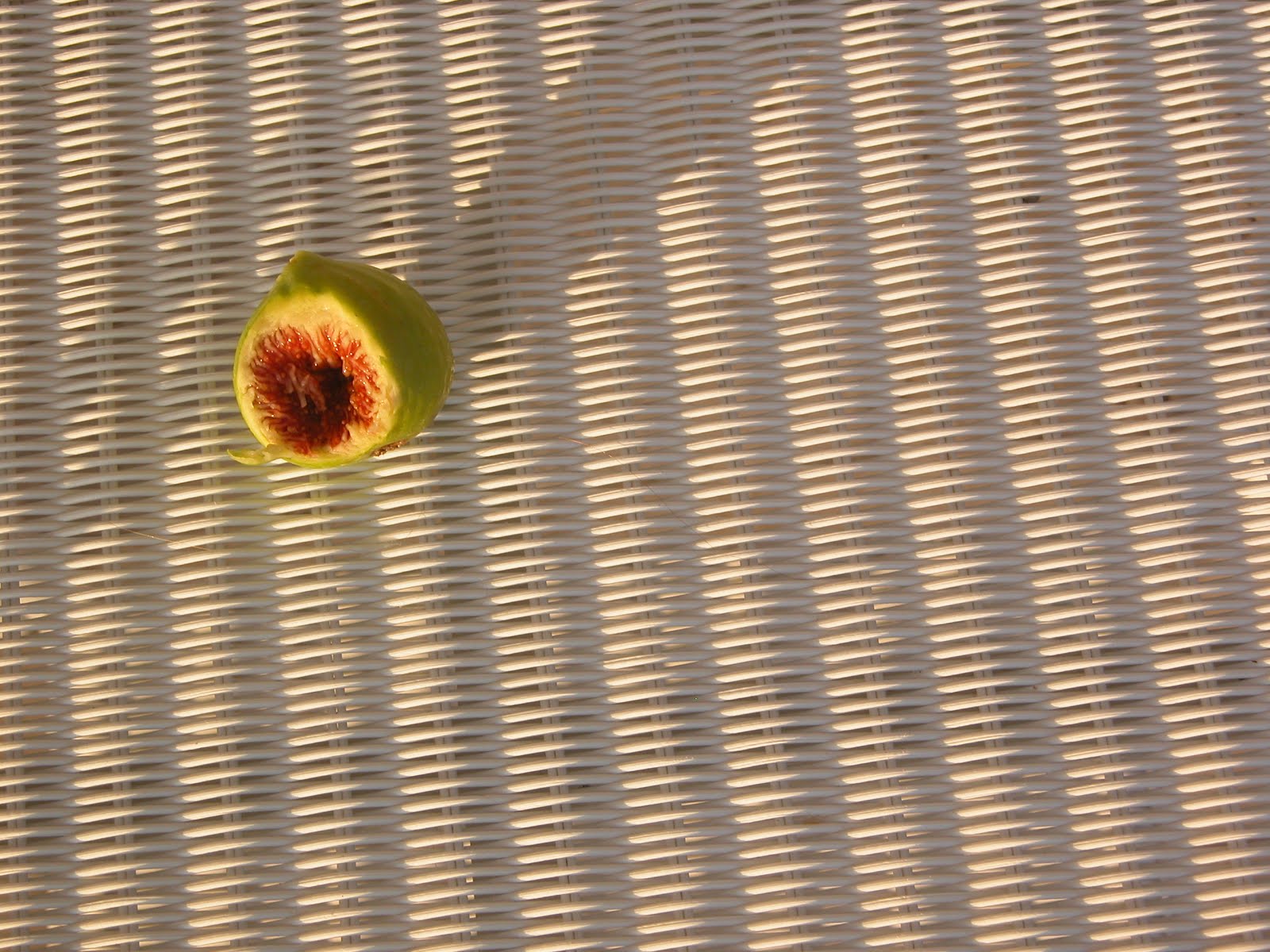
Oh, fig!
Spotted......More......
Picked, rinsed and...
bitten.
Aaaahhhh, memories of sunny warm summer on a gray chilly Milanese autumn day.
Picked, rinsed and...
bitten.
Aaaahhhh, memories of sunny warm summer on a gray chilly Milanese autumn day.
Tuesday, September 11, 2012
Today's semi-random thoughts from Marcus Aurelius
'People seek out retreats for themselves in the country, by the seaside, on the mountains, and you, too, are wont to long above all for such things. But all this is unphilosophical to the nth degree, when you can at a moment's notice retire into yourself. For nowhere can we find a retreat more full of peace, or more free from care, than our own souls, above all if...More......
...we have peace within us, a steadfast look at which and we at once are at ease, and by "ease" I mean nothing other than order. Make use, then, of this retirement continually, and regenerate yourself....
Why with what are you discontented? The wickedness of others? Take this conclusion to heart, that rational creatures have been made for one another, that forbearance is part of justice, that wrong-doing is involuntary, and think how many before now, after passing their lives in implacable enmity, suspicion, hatred, and at daggers drawn with one another, have been buried. Think of this, I say, and stop fretting.
But are you discontented with your share in the whole? Recall the alternatives: either heavenly intervention, or just atoms, and the abundant proofs that the universe is one state....
But will that paltry thing, Fame, distract you? Look at the swift approach of complete forgetfulness, and the void of infinite time on this side of us and on that, and the empty echo of acclamation, and the fickleness and uncritical judgment of those who claim to speak well of us, and the narrowness of the arena to which all this is confined. For the whole of earth is but a point, and how tiny a corner of it is this the place of our sojourning, and how many therein and of what sort are those who will praise you.
From now on, therefore, remember to retreat into this little plot that is you, yourself. Above all, don't distract yourself, don't be too eager, but be your own master, and look upon life as one possessed of high values, as a human being, as a citizen, as a mortal creature.
Among the principles close at hand upon which you concentrate, let there be these two. One, that objective things do not lay hold of your soul, but stand quietly outside of it, while disturbances are but the outcome of that opinion that is within us. Second, that all this visible world changes in a moment, and will be no more, and continually remember the changes of how many things that you have witnessed.
"The Universe: change. Life: opinion".(*)'
Dear Marcus usually isn't so long-winded, but much of the essence of his helpful and comforting thought, expressed in his jottings to self that we now call his Meditations, is distilled into this somewhat paraphrased passage (IV:3).
Perfect for remembering, for today and for my dear dear Mario, whose passing away two years ago took the light from my life.
Contemplate. Contemplate again. And again. Draw comfort from wisdom.
(*Here, Marcus is quoting Mundi lex seu Natura, according to my Loeb version.)
...we have peace within us, a steadfast look at which and we at once are at ease, and by "ease" I mean nothing other than order. Make use, then, of this retirement continually, and regenerate yourself....
Why with what are you discontented? The wickedness of others? Take this conclusion to heart, that rational creatures have been made for one another, that forbearance is part of justice, that wrong-doing is involuntary, and think how many before now, after passing their lives in implacable enmity, suspicion, hatred, and at daggers drawn with one another, have been buried. Think of this, I say, and stop fretting.
But are you discontented with your share in the whole? Recall the alternatives: either heavenly intervention, or just atoms, and the abundant proofs that the universe is one state....
But will that paltry thing, Fame, distract you? Look at the swift approach of complete forgetfulness, and the void of infinite time on this side of us and on that, and the empty echo of acclamation, and the fickleness and uncritical judgment of those who claim to speak well of us, and the narrowness of the arena to which all this is confined. For the whole of earth is but a point, and how tiny a corner of it is this the place of our sojourning, and how many therein and of what sort are those who will praise you.
From now on, therefore, remember to retreat into this little plot that is you, yourself. Above all, don't distract yourself, don't be too eager, but be your own master, and look upon life as one possessed of high values, as a human being, as a citizen, as a mortal creature.
Among the principles close at hand upon which you concentrate, let there be these two. One, that objective things do not lay hold of your soul, but stand quietly outside of it, while disturbances are but the outcome of that opinion that is within us. Second, that all this visible world changes in a moment, and will be no more, and continually remember the changes of how many things that you have witnessed.
"The Universe: change. Life: opinion".(*)'
Dear Marcus usually isn't so long-winded, but much of the essence of his helpful and comforting thought, expressed in his jottings to self that we now call his Meditations, is distilled into this somewhat paraphrased passage (IV:3).
Perfect for remembering, for today and for my dear dear Mario, whose passing away two years ago took the light from my life.
Contemplate. Contemplate again. And again. Draw comfort from wisdom.
(*Here, Marcus is quoting Mundi lex seu Natura, according to my Loeb version.)
Sunday, July 8, 2012
Summertime reminder: do NOT buy from street vendors
Some things spread out on a makeshift table, on a sheet, or directly on the ground. Roving (usually) fellows pushing bracelets, umbrellas and whatnots at you. You've seen it. You might even have been tempted to buy something from one of them.
That faux name brand bag or pair of sunglasses does look so convincing, it's so lovely, and it costs a fraction of the original. Maybe it is real (if so, it's probably stolen). It suddently has started to rain cats and dogs....More...
Do NOT give in to temptation!
First of all, you're risking an enormous fine, beginning at Euro 1,000.00!
Look what the U.S. government page on travel to Italy has to say:
"According to Italian Law (Law 80 of May 14, 2005), anyone caught buying counterfeit goods (for example, DVDs, CDs, watches, purses, bags, belts, sunglasses, etc.) is subject to a fine of no less than EUR 1,000. Police in major Italian cities enforce this law to varying degrees. You are advised to purchase products only from stores and other licensed retailers to avoid unknowingly buying counterfeit and illegal merchandise."
Second of all, you're feeding the various mafias and crime.
Third of all, those vendors do not pay taxes (which means us honest folks have to pay more taxes to compensate for your ill-advised action), and the products have not passed safety tests, and may even be harmful (sunglasses probably don't have the UV filter necessary for protecting your eyes, and things for children are probably toxic, flammable and have lots of dangerous detachable pieces).
Be wise!
That faux name brand bag or pair of sunglasses does look so convincing, it's so lovely, and it costs a fraction of the original. Maybe it is real (if so, it's probably stolen). It suddently has started to rain cats and dogs....More...
Do NOT give in to temptation!
First of all, you're risking an enormous fine, beginning at Euro 1,000.00!
Look what the U.S. government page on travel to Italy has to say:
"According to Italian Law (Law 80 of May 14, 2005), anyone caught buying counterfeit goods (for example, DVDs, CDs, watches, purses, bags, belts, sunglasses, etc.) is subject to a fine of no less than EUR 1,000. Police in major Italian cities enforce this law to varying degrees. You are advised to purchase products only from stores and other licensed retailers to avoid unknowingly buying counterfeit and illegal merchandise."
Second of all, you're feeding the various mafias and crime.
Third of all, those vendors do not pay taxes (which means us honest folks have to pay more taxes to compensate for your ill-advised action), and the products have not passed safety tests, and may even be harmful (sunglasses probably don't have the UV filter necessary for protecting your eyes, and things for children are probably toxic, flammable and have lots of dangerous detachable pieces).
Be wise!
Sunday, March 11, 2012
Yes, I honestly do love Milan...
It's beautiful, folks!
Stop seeing the city through the gray-colored lenses of prejudice.
The city is lovely...snippets of ancient, medieval and Renaissance lives peek out from around the corners of the more present Baroque, Neo-Classical, Belle Epoque, Liberty (that's Milanese Art Nouveau, in case you haven't been following my blog, yet), Novecento and modern (and some of the post-war stuff is even decent, too). (Yes, yes, yes, there are some pretty dull and, I hear, dangerous rabbit warrens in the suburbs, but there are enough people complaining about Milan, you don't need me to do that.)
The city is also fascinating and lively (though I'm [repeatedly] told it was even more wonderful and lively in the 1960s, but we don't choose when and where we're born, do we?!). There's so much to do, and for so many different interests, that I don't even scratch the surface.
It's pretty easy to get around...I love not having to drive a car. Thank you ATM! (Could you please stop striking so often, though? Get your act together, and TALK sufficiently before deadlines, please. I know striking is a legal right in Italy, but it should be a last option, not an omnipresent club hovering over the heads of the poor and middle class, who can't afford private drivers and taxis up the wazoo. Thank you for listening, I'll get off my soapbox, now....)
The people used to be polite...ahhhh, that sounds too much like an incipient complaint, so let's move on.
The city even can be picturesque! Ain't that picture urban-cute? (I snapped it with you in mind a few Saturdays ago, around 9 A.M. for your personal, non-commercial fun.)
I could go on and on and on, but then what would be the point of any future posts?
So, why do so many people--Milanese, imported Italians and ex-pats alike--goggle, when I say that I love Milan?
Here's the historian in me coming out.
Personally, I think that Italians haven't had their "Mount Ventoux."
Huh?
Petrarch is often cited as one of the turning points in modern occidental thought. Why?
Because he literally had his Mount Ventoux.
He climbed to the top of the mountain to see the view (already cited as something "new"...who ever heard of going to all that trouble and fatigue just to look out over the surrounding area? "You mean, he's not even going to gather mushrooms? The man's nuts!"), and for the first recorded/significant time realized that there was an immense gap between him and antiquity.
He felt the gap.
He felt a longing for what was no longer his: classical culture.
He felt nostalgia.
At least until recently, for the period prior to Petrarch scholars talk about a continuity of mentality, rather than a rift.
The Early Christians--aside from their new religion, and there were other "mystery" religions proliferating, too--felt fully Roman, fully Greek, fully whatever they were. Changing religion didn't change the fact that you and your family had been born, lived and died in Ephesus, Rome, Milan, Jerusalem, or even the tiniest waterhole on the way to Timbuktuu.
The Carolingian renascence refreshed, rather than revived, ancient culture, where it already had existed, and spread it (also for socio-political reasons) where it hadn't.
Medieval images of ancient and biblical people were cast in then modern clothes. "They are just like us; we're just like them."
Then in a literal (or was it a topos?) flash, Petrarch saw.
He saw that he was separate from the classicism he so dearly loved.
He saw that he was different.
He appreciated the classicism, and mourned the gap.
And so today's Italians have not yet had their Mount Ventoux.
The late nineteenth and early twentieth centuries--so evident in Milan because they were a fervent period of economic booms and busts...ring any bells?...--is still seen as a part of them (and the good things about the Novecento period are still swept under the rug along with the bad).
"What's so special about this? It looks just like my grandma's house," I hear while I'm at work at the Bagatti Valsecchi Museum (via Gesù 5), a marvelous authentic magic window onto our recent and traditional aristocratic past.
Sigh.
So, give yourselves a shake.... No, not that kind of chocolate, or vanilla, shake.
A wiggling from side-to-side, clear your head of cobwebs.
And see beautiful Milan for what it is.
It helps if you raise your eyes from the sidewalk....
Enjoy!
Sunday, December 18, 2011
Today would have been...
I love life, this infinite ship, this reawakened dream, this book never printed, often disordered as a handful of folded sheets of paper, as single sheets of paper, as snippets of phrases now here, now there in this room in which you have just walked, you go back and walk through it, again, and find it another and different and you translate into time your steps and into memories the corners. Somewhere there is, but I don't know where, no one knows where, a hidden door and the walls that seemed four, because thus swore the geometry of the mind, are many, too many more.
(Roberto Vecchioni, Eng. trans. S.K. Meyer)*
My dear sweet husband, I miss you so much.... Where is the door that will take me to you?
*("Amo la vita, questa nave infinita, questo sogno svegliato, questo libro mai stampato, spesso disordinato a quinterni di pagine, a fogli singoli, a stralci di frasi ora quà ora là in questa stanza che appena l'hai camminata, torni a ripercorrerla e la trovi altra e dispari e traduci in tempo i passi e in memoria gli angoli. C'è da qualche parte, ma io non so dove, nessuno qui sa dove, una porta nascosta e le pareti che sembravano quattro perché così giurava la geometria della mente, sono molte troppe di più." Roberto Vecchioni, "Quell'inutile voglia di imparare," SETTE, 17 dicembre 2009)
Wednesday, November 2, 2011
At the Famedio (Milan's "Pantheon") the "Greats of Milan" will be honored, today, including my dear sweet departed husband, Prof. Em. Mario Tiengo
I don't usually share personal things on this blog, lots of other people do that so you don't need yet another stream o' consciousness, but today my personal life and wonderful Milan coincide. Today, my dear sweet husband, Mario Tiengo, whose death a year ago blew out the light in my life, is being honored among the "Greats of Milan."...More......
How to sum up such a great man in so few words? How to even begin to record, let alone transmit, everything he did for Italians suffering from acute, chronic and psychogenic pain? For palliative care? For those giving childbirth, preferably painlessly? To raise the awareness of general practitioners and pharmacists about pain therapy? The international fame that he brought to Milan? His almost countless publications and organized conferences, his participation in the founding of so many principal Italian anesthesiology and pain therapy professional associations and journals?
For decades dedicated to profound scientific, philosophical, cultural and sociological studies in the field, Mario founded the world's first university chair in the physiology and therapy of pain at the State University of Milan in 1982, and covered the role until his retirement in the 1990s.
He founded and directed one of the first, if not the first, pain clinics in Italy, the Padiglione Bergamasca, made possible by a generous donation of the Bergamasca-Visconti family in honor of one of their beloved family members whom Mario had helped.
He founded and directed the Anesthesiology and Intensive Care department at Milan's Mangiagalli hospital dedicated to gynecology and obstetrics, bringing epidural analgesia to Italian women.
He participated in the birth of palliative care in Italy, though his focus remained acute, chronic and psychogenic pain.
The latter interested him particularly in the last decades of his life because he saw in it a heuristic tool for trying to understand the great philosophical question that has fascinated humans for millennia, the 'brain-mind' question, in other words, where does our consciousness come from, a soul that is a thing existing apart from the body, or the 'mere' result of the incredible complexity of our brains? Scientists succeed in finding ever smaller particles and ever more rapid electrical and chemical transmissions, but we still don't know what connects our outer reality to our inner reality. For this reason, of all the historic great minds his favorite was Descartes, who thought to identify this point of contact in what he called the "pineal gland." "Let us not disparage Descartes for his 'poor science', rather, let us remember that he described and analyzed using the knowledge and terminology of his day," Mario always said, "just because something can't be detected and measured doesn't mean that it doesn't exist...it might mean that we simply don't have the right tools, yet."
Open minded, with a sincere interest in all and others around him, a big heart, genuinely concerned for his patients, whom he saw as sufferers and not as numbers, a scintilating intellect and a captivating speaker and teacher able to gauge even the most complicated concepts to the audience he had in front of him, an adored and adoring husband, a life and soul companion, his death has left Milan and the world much poorer, and has left me teetering on the edge of a bottomless abyss, held up only by the wings of his love.
Born in the Veneto, but transferred to Milan to get his medical degree, Mario remained in this marvelous city, learned to speak the Milanese dialect, and--like me--became an adopted Milanese, unable even to conceive of living somewhere else.

Thank you, Milan, for this great honor bestowed on such a great and worthy man.
(For more about Prof. Em. Mario Tiengo, here's the website I dedicated to him; he wrote the texts in Italian, and I translated them into English: "Good Evening Doctor," http://sites.google.com/site/goodeveningdoctor/)
Saturday, July 30, 2011
Sunday, July 24, 2011
Still glorious weather in Milan...
...still chained to my desk, working.... (sigh)
(see the last Wordless Wednesday...today is marvelously more o' the same)
Friday, April 29, 2011
Photoless Friday (11): preparations and a snipped of Marcus Aurelius
Fixing a special dinner, today. Special for its memories, special for its purpose, special for its guests.
Grocs then the preparation (while watching William and Kate's wedding, and wishing them well) of the various dishes (I'm taking photos along the way for you) is gobbling up the day, and I've gotta run, but wanted to share the day with you, and felt in the need of a snippet of Marcus Aurelius.
Opened truly at random, it's the absolutely perfect comfort for me. Perhaps my paraphrase will help you, too:
'Even an obvious and quite brief aphorism can serve to warn those infused with the true doctrines against giving way to grief and fear, for instance:
Such are the races of men as the leaves that the wind scatters earthwards
and your loved ones, too, are little leaves.... For all these things
burgeon again with the season of spring
and the wind then casts them down, and the forest puts forth others in their stead. Transitoriness is the common lot of all things.'
Marcus Aurelius, Meditations, Book X, verse 34
Grocs then the preparation (while watching William and Kate's wedding, and wishing them well) of the various dishes (I'm taking photos along the way for you) is gobbling up the day, and I've gotta run, but wanted to share the day with you, and felt in the need of a snippet of Marcus Aurelius.
Opened truly at random, it's the absolutely perfect comfort for me. Perhaps my paraphrase will help you, too:
'Even an obvious and quite brief aphorism can serve to warn those infused with the true doctrines against giving way to grief and fear, for instance:
Such are the races of men as the leaves that the wind scatters earthwards
and your loved ones, too, are little leaves.... For all these things
burgeon again with the season of spring
and the wind then casts them down, and the forest puts forth others in their stead. Transitoriness is the common lot of all things.'
Marcus Aurelius, Meditations, Book X, verse 34
Tuesday, April 19, 2011
Semi-random thought from Marcus Aurelius for the day
Why am I so enamored of Marcus Aurelius? If previous messages haven't clarified this, maybe I'll attempt a few words, later. Right now, I've barely got enough time to jot you today's semi-random thought from his "Meditations"...More......
...parapharased in my words, here goes:
'It brings gladness to a human heart to do the true work of humankind. And the true work of humankind is to show goodwill to others, to disdain being too moved by our sense perceptions, to discern specious impressions, to take a comprehensive view of the Nature of the Universe and of everything that is done at its bidding.
You have three relationships: the first to that vessel your body in which you are contained; the second to the divine Cause from which issue all things to everyone; the third to those that live with you.' (Book VIII, verses 26 and 27; Loeb edition)
Marcus' thought can be meaningful for you, wherever you find yourself on the spectrum of religious thought, from traditional approaches firmly convinced of the existence of a god, or gods, an approach supplying a comforting system of behavior precepts and a system of punishments and rewards, to those accepting the mystery of the mere fact of existence, with the consequent enormous personal responsibility for comportment, which best fulfils the thinker positively, while respecting the environment and fellow inhabitants of our world.
Sometimes, as in this case, he refers to "Nature," other times to the "Gods." Interpret these references as you will, and absorb his respect for self, for those around us, for the world in which we live.
Yes, yes, yes, we need to plan for our futures, but keep the center of your soul firmly rooted in the here and now because the past is gone, the future may never come, all we have is this present moment. Use it to be a better, happier, more positive person. Kiss your spouse, your kids, your friends goodbye each time you take your leave of them; have a kind word for each, treat yourself, your co-workers, your employees, the environment with respect. You may never have another chance to say "I love you."
The center of your soul will become more resilient, able to withstand better the buffeting winds, now soft, now battering, of daily life, and you'll spend each waking moment with part of your conscious self "stopping to smell the roses" as you scurry along with the rest of us in this fragile rat race called life.
This post is dedicated to everyone, who has recently lost a dear friend, or family member.
Remember the positive, evoke the love and laughter, let the sharp edges of grief gradually be blunted.
The sharp knife of loss, the terrible void, always will be there, but you can learn to live with it, if you invoke the positive presence of the missing loved one to keep you company on the rest of your journey.
I snapped this shot with you in mind on April 13th at about 4:15 P.M. in Piazza Virgilio, Milan, Italy.
Sunday, March 20, 2011
A lovely lovely walk after days of rain (and the flu)...Here my are!
Don't drive, it's late and dark, and don't want to risk the bus (limited info in English), but can't afford a taxi, especially repeatedly? There's an excellent compromise available: RadioBus. Like any compromise, there's good and bad. The good part is that at the appointed time a small van passes at a pre-appointed point near where you are, and--for just twice the price of a bus trip--will take you to a pre-appointed place very close to home. The bad part is that the service isn't available during the day time (so as not to compete too much with taxis), and can be reserved only up to three days in advance, so--with that time limit--there isn't always a seat available (especially if you're more than one person). But it's still a great deal.A perfect Milanese day.
Friday, November 26, 2010
More than Photoless Friday (07), I should say Imageless Friday
More than "photoless Friday," today I should say "imageless Friday." (And there will be some snow and T-Day comments, too, so do read on...!)...More......
In 1953, using transmitters constructed thanks to the funds provided by the Marshall Plan (!), Italian television began to transmit in black and white.
This morning, in honor of that year, the analog transmissions of RAI (the national Italian television company) in Lombardy shut off a few minutes ago at 7:53 A.M., and simultaneously the digital transmissions began. Now there are only a few stations that still transmit in analog signals...for now. I managed to find one local Italian channel still transmitting in analog, at least for a few minutes more (update: OMG, it takes me this long to write these posts? It's already 9:10 A.M., and that one went off, too!), but for how long? Will have to get a transformer...one of these days....
Serendipitously, after a gorgeous blue, but chilly, day yesterday, it is supposed to snow this morning (and again day after tomorrow, it is winter, after all), so I think I'll give myself permission to set aside chores and worries, bundle up, and head out with my camera to see what I can find for you.
Oh yes, I also wanted to mention that last night I had the loveliest Thanksgiving Day dinner I have ever had since becoming an ex-pat. Despite the fact that T-day is my favorite American holiday, a time to take stock, muse, and count blessings, and, ahem, to eat--guilt free--some of my favorite things, it always sneaks up on me because there are no external reminders, and then it's too late.
The company was delightful, people quite different one from the other, but open to serene exchanges and warm-hearted smiles. The restaurant had done its best to offer a traditional American-style T-day dinner, with refined touches (how could they resist?), and, I must say, for the most part, they succeeded.
Some small differences were, let's say, acceptable variations (the pumpkin soup was deliciously thick, but the very small portion turned out to be a blessing because it had been a bit overspiced with something, perhaps ginger and/or white pepper, the turkey was a breast with the stuffing rolled up into it...interesting..., while the gravy was too thin, but still tasty, and the cranberry sauce was not only a bit thin, but also VERY tart, but it still was such a comfort, since cranberries are impossible to find here, and the sauce is almost impossible to find), another was a welcome variation (what they called "sweet potatoes"--which I really hate--were not OUR orange gaggingly sweet potatoes, but an oatmeal colored mash of only slightly sweet whatever-it-was, and so it was quite tasty), another two were a bit of a disappointment because of expectations, but in and of themselves very good (pumpkin cheesecake that was my less-preferred mousse-style cheesecake, and not detectably pumpkin-y, while what had been touted as traditional American apple pie was anything but traditional, it was more like a sweet apple pizza, but, what the heck, they were still good), and there was the teentsy-est spoon plop of mashed potatoes that I have ever seen in my entire life (portions in some American restaurants are too gigantic, and facilitate obesity too easily, anyway), but at the end of the dinner, my tummy was, like Goldilock's porridge, just right, not too much and not too little, and my heart glowed with the comforting company.
Just what the doctor ordered.
We thanked the restaurant for the good idea of a thematic dinner, hoping they'll do it, again, and I herewith officially and sincerely thank the delightful friends, who kindly invited me to share their festive table.
It has left a much needed happy glow.
For them, I am thankful.
In 1953, using transmitters constructed thanks to the funds provided by the Marshall Plan (!), Italian television began to transmit in black and white.
This morning, in honor of that year, the analog transmissions of RAI (the national Italian television company) in Lombardy shut off a few minutes ago at 7:53 A.M., and simultaneously the digital transmissions began. Now there are only a few stations that still transmit in analog signals...for now. I managed to find one local Italian channel still transmitting in analog, at least for a few minutes more (update: OMG, it takes me this long to write these posts? It's already 9:10 A.M., and that one went off, too!), but for how long? Will have to get a transformer...one of these days....
Serendipitously, after a gorgeous blue, but chilly, day yesterday, it is supposed to snow this morning (and again day after tomorrow, it is winter, after all), so I think I'll give myself permission to set aside chores and worries, bundle up, and head out with my camera to see what I can find for you.
Oh yes, I also wanted to mention that last night I had the loveliest Thanksgiving Day dinner I have ever had since becoming an ex-pat. Despite the fact that T-day is my favorite American holiday, a time to take stock, muse, and count blessings, and, ahem, to eat--guilt free--some of my favorite things, it always sneaks up on me because there are no external reminders, and then it's too late.
The company was delightful, people quite different one from the other, but open to serene exchanges and warm-hearted smiles. The restaurant had done its best to offer a traditional American-style T-day dinner, with refined touches (how could they resist?), and, I must say, for the most part, they succeeded.
Some small differences were, let's say, acceptable variations (the pumpkin soup was deliciously thick, but the very small portion turned out to be a blessing because it had been a bit overspiced with something, perhaps ginger and/or white pepper, the turkey was a breast with the stuffing rolled up into it...interesting..., while the gravy was too thin, but still tasty, and the cranberry sauce was not only a bit thin, but also VERY tart, but it still was such a comfort, since cranberries are impossible to find here, and the sauce is almost impossible to find), another was a welcome variation (what they called "sweet potatoes"--which I really hate--were not OUR orange gaggingly sweet potatoes, but an oatmeal colored mash of only slightly sweet whatever-it-was, and so it was quite tasty), another two were a bit of a disappointment because of expectations, but in and of themselves very good (pumpkin cheesecake that was my less-preferred mousse-style cheesecake, and not detectably pumpkin-y, while what had been touted as traditional American apple pie was anything but traditional, it was more like a sweet apple pizza, but, what the heck, they were still good), and there was the teentsy-est spoon plop of mashed potatoes that I have ever seen in my entire life (portions in some American restaurants are too gigantic, and facilitate obesity too easily, anyway), but at the end of the dinner, my tummy was, like Goldilock's porridge, just right, not too much and not too little, and my heart glowed with the comforting company.
Just what the doctor ordered.
We thanked the restaurant for the good idea of a thematic dinner, hoping they'll do it, again, and I herewith officially and sincerely thank the delightful friends, who kindly invited me to share their festive table.
It has left a much needed happy glow.
For them, I am thankful.
Labels:
Blessings,
Holidays,
Musings,
Photoless Friday,
snow,
Thanksgiving,
TV
Tuesday, November 23, 2010
Leaves of grass and the birth of the Italian nation
Leaves of grass and the birth of the Italian nation...huh?
It's all about life priorities, a topic foremost in my mind for months, and a question I've posed to my ESL students, so why not open a discussion about it on my blog dedicated to Milan?...More...
It's always good to stop and smell the roses, but are you really? (HINT: you might cherish this thought, you might even THINK that you are doing this, already, but, until a wrenching tragedy strikes you or a loved one--Cosmos forbid that it should--you probably are only scratching the surface of those proverbial rose petals.)
Poignant Stoic thoughts run through many of the spiritually-oriented (as opposed to religious institutionally-oriented) readings I enjoy. Here is one immediately at hand, which might help you think, think, and think, again, whatever religion you may (or may not) profess:
'Human life is frail, fame and everything good in it is like grass, like the flowers in the fields, which wither and fade away' (my paraphrase of Isaiah 40:6-8 and I Peter 1:24 of the King James version of the Christian Bible)
How to cope with this fragility?
A popular saying in English (someone surely will look it up on Bartlett's Quotations, and tell me...right now, I'm too lazy to do it): 'Build as if you will live forever, but live as if you will die tomorrow.'
Carpe diem.
In the real sense.
Not 'Eat, drink and be merry, for tomorrow we may die' (another old hat phrase in English), but in the true Stoic sense:
'Live in the present, live each moment to its fullest, doing your best to be a better person, for your self, for those around you, for the world.'
Or, to paraphrase Marcus Aurelious, my most cherished author:
'Let your every deed and word and thought be those of someone, who can depart from life this very moment. How quickly everything vanishes: physical things from the universe, memories of them in eternity, and the ephemeral and worthless sense perceptions.
'What is it to die, but a function of nature? We need only to associate ourselves with the divine spark that is in our hearts, and to serve it truly. How do we do this? By keeping it pure from passion and aimlessness and discontent with anything that proceeds from the Universe, or our fellow men because whatever comes from the Universe is worthy of reverence, and whatever comes from men, if from love, will be compassionate, but if evil, from ignorance.
'In the end, the present lasts just as long for everyone. The past is already gone, the future is not yet here, so we can't lose either. So it is only the present from which we might depart, and the present is only what we make of it, how we view it. In a word, all the things of the body are as a river, and everything of the soul like a dream and a vapor. Life is like warfare and a pilgrimage, and fame after death is only forgetfulness.
'What then can help us on our way? One thing, and one thing only: Philosophy. And this consists in keeping the divine spark within us pure and unwronged, lord of all pleasures and pains, doing nothing aimlesslessly, or with deliberate falsehood and hypocrisy, independent of others' actions or inactions, and, in particular, welcoming whatever comes as natural, and above all, waiting for death with good grace, as a liberation, as a natural part of the cycle of life.' (Meditations, II:11-17)
What does this have to do with Milan?
Like so many other cities, Milan is studded with memorials to heroes. This year also is the 150th anniversary of the official birth of the Italian nation (though that effort stretched over a number of years, in reality).
Fame is fleeting. We live in the memory of others only so long as they live, but to have done something positive for those around us, whether on a small personal scale, or a larger civic, or national, scale, to love, truly love, those around us, and put our priorities in a proper order, in short, to examine our lives on a daily basis, that, I think, is one of the fundamental essences of what it means to be truly human.
In the days to come, I think I'll post some of those memorials around Milan.
Thanks for listening.
If you prefer a funny, but poignant, way to say all this, there's a good story floating around the internet about a philosophy professor, golf balls, pebbles sand and coffee (or beer, depending on your personal preferences). Here's just one link of many: http://towherenow.com/?p=184
It's all about life priorities, a topic foremost in my mind for months, and a question I've posed to my ESL students, so why not open a discussion about it on my blog dedicated to Milan?...More...
It's always good to stop and smell the roses, but are you really? (HINT: you might cherish this thought, you might even THINK that you are doing this, already, but, until a wrenching tragedy strikes you or a loved one--Cosmos forbid that it should--you probably are only scratching the surface of those proverbial rose petals.)
Poignant Stoic thoughts run through many of the spiritually-oriented (as opposed to religious institutionally-oriented) readings I enjoy. Here is one immediately at hand, which might help you think, think, and think, again, whatever religion you may (or may not) profess:
'Human life is frail, fame and everything good in it is like grass, like the flowers in the fields, which wither and fade away' (my paraphrase of Isaiah 40:6-8 and I Peter 1:24 of the King James version of the Christian Bible)
How to cope with this fragility?
A popular saying in English (someone surely will look it up on Bartlett's Quotations, and tell me...right now, I'm too lazy to do it): 'Build as if you will live forever, but live as if you will die tomorrow.'
Carpe diem.
In the real sense.
Not 'Eat, drink and be merry, for tomorrow we may die' (another old hat phrase in English), but in the true Stoic sense:
'Live in the present, live each moment to its fullest, doing your best to be a better person, for your self, for those around you, for the world.'
Or, to paraphrase Marcus Aurelious, my most cherished author:
'Let your every deed and word and thought be those of someone, who can depart from life this very moment. How quickly everything vanishes: physical things from the universe, memories of them in eternity, and the ephemeral and worthless sense perceptions.
'What is it to die, but a function of nature? We need only to associate ourselves with the divine spark that is in our hearts, and to serve it truly. How do we do this? By keeping it pure from passion and aimlessness and discontent with anything that proceeds from the Universe, or our fellow men because whatever comes from the Universe is worthy of reverence, and whatever comes from men, if from love, will be compassionate, but if evil, from ignorance.
'In the end, the present lasts just as long for everyone. The past is already gone, the future is not yet here, so we can't lose either. So it is only the present from which we might depart, and the present is only what we make of it, how we view it. In a word, all the things of the body are as a river, and everything of the soul like a dream and a vapor. Life is like warfare and a pilgrimage, and fame after death is only forgetfulness.
'What then can help us on our way? One thing, and one thing only: Philosophy. And this consists in keeping the divine spark within us pure and unwronged, lord of all pleasures and pains, doing nothing aimlesslessly, or with deliberate falsehood and hypocrisy, independent of others' actions or inactions, and, in particular, welcoming whatever comes as natural, and above all, waiting for death with good grace, as a liberation, as a natural part of the cycle of life.' (Meditations, II:11-17)
What does this have to do with Milan?
Like so many other cities, Milan is studded with memorials to heroes. This year also is the 150th anniversary of the official birth of the Italian nation (though that effort stretched over a number of years, in reality).
Fame is fleeting. We live in the memory of others only so long as they live, but to have done something positive for those around us, whether on a small personal scale, or a larger civic, or national, scale, to love, truly love, those around us, and put our priorities in a proper order, in short, to examine our lives on a daily basis, that, I think, is one of the fundamental essences of what it means to be truly human.
In the days to come, I think I'll post some of those memorials around Milan.
Thanks for listening.
If you prefer a funny, but poignant, way to say all this, there's a good story floating around the internet about a philosophy professor, golf balls, pebbles sand and coffee (or beer, depending on your personal preferences). Here's just one link of many: http://towherenow.com/?p=184
Subscribe to:
Posts (Atom)