Saturday, July 27, 2013

Plan A and Plan B for a Sunny Sunday afternoon: the Pinacoteca of Brera

Next on the express tour of Milan's museums is the Museum of the Duomo of Milan.

That was Plan A...until...More......

...I got there, and saw the sign saying that the museum is still closed for renovation...until November 2013 (or...?). Let the visitor beware.

Plan B: one of the other museums on the ENI freebie list, or the Pinacoteca of Brera. Couldn't remember any of the first, so headed to the second down via Brera, where I passed this great vintage shop and immediately afterwards a "Profumo" (perfume) shop, where they mix perfumes for you. Must cost a mint. Not to be confused with Olfattorio, which also has lovely quality perfumes, but is right across the street.

Now for Brera. A medieval Milanese word for 'garden' or 'orchard' like those that used to characterize this area in the band of land running between where the ancient Roman (now via Orso-via Cusani) and the medieval (now via Pontaccio, because of a bad bridge, or "ponte") walls used to go.

The story is long (I can make any story long!), so will cut to the chase: previously in the hands of the Umiliati, a group of lay and religious believers founded in the medieval period, but that got itself into deep you-know-what after trying to assassinate the Cardinal Carlo Borromeo, the land was handed by the selfsame cardinal to the new order of Jesuits in 1572, who had the Umiliati's building first enlarged and then radically transformed by a series of the most important architects of the day: Bassi, Ricchini, Quadrio e Rossone. Then the Jesuits got themselves into trouble, their order was suppressed in 1772 (lots of monasteries and churches were being suppressed by the Hapsburgs ostensibly and even possibly really because they were corrupted by wealth...which devolved to the imperial treasure chests...), and the Austrian Hapsburgs, then in charge of Milan, transformed the structure for functions to benefit the general populace: a botanical garden, an astronomy center and--moving there the art school originally at the Pinacoteca Ambrosiana where it had been founded by Carlo's younger cousin, Federico--an art gallery. The most important architect in Milan at the time, Piermarini, was in charge of adapting the structure to its new lay functions, and adding the monumental white portal.

As long as we're on a panoramic history roll, the building at the back of the little piazza to the right of the image once was a church, but was deconsecrated and deconstructed to accomodate more art galleries under Napoleon (another one keen on suppressing religious orders and monasteries and absorbing their great wealth) at the beginning of the 19th century. Fragments of the church and a gigantic blow-up of a then contemporary print of the church's façade is permanently on view in the "Arte Antica" museum of the Sforza Castle.

Passing through the entryway (monuments to artists, architects, writers and scientists abound) the brightness of the courtyard, the regular rhythm of the double-columned arches, the largeness of the space amaze.

In the center, a 1984 copy of the bronze sculpture commissioned in 1807 by Viceroy Eugene Beauharnais (Josephine's son) from Canova of Napoleon as Mars the Peacemaker ("pacifier" means something else in English!). Because of the back-and-forth of French and Austrian and Milanese control of the city in those turbulent times, the original was installed only in 1859, immediately after the Milanese had retaken control--this time permanently--of their city.

Are you, or one of your group, in a wheelchair? Go straight across the courtyard, into the door to the left of the sculpted water spout, turn immediately to your left, and, just a dozen steps down a short hall, go through the door at the end and into that other courtyard at the far end of which you'll see the little signs for handicapped service. You can call (tel. 02 722 63 264 or 02 722 73 229) or fax (02 720 011 40) them ahead of time, but it's not necessary. And there's a plus: the person in the wheelchair and the person accompanying them get in free.

If you can walk up the stairs, just before the fountain, take the large stairs up the left...

...passing the 1838 monument by the famous sculptor Pompeo Marchesi to the writer Beccaria, or...

...to the right, passing the 1838 monument by Gaetano Matteo Monti to the writer Parini.

At the head of the stairs, a 1959-60 rider and horse by Marino Marini.

Turn right, and at the end of this flank of the courtyard is the current entrance to the museum (despite the fact that it is unmarked).

You enter the museum through the bookshop (don't worry, you exit through it, too) with a monument to the early 19th century painter, Appiani. Head to the back, and turn right. You'll go first through a small room with lockers for large backpacks and places for umbrellas. Beyond that, the museum starts...and they now don't allow photos, even without flash (though they did the last time I was there...always ask...always follow the rules...don't contribute to the 'ill-mannered tourist' prejudice).

The rooms run around--sometimes in parallel series--the large courtyard in an order that is roughly chronological and organized by general areas. The first paintings are fresco fragments by the very talented Bramante, just the first in the Brera's large collection with interesting and excellent pieces and many masterpieces, including Mantegna's "Dead Christ," Raphael's "Marriage of the Virgin," and Piero della Francesca's altarpiece with the suspended ostrich egg. Some of the rooms might be closed...funds are too short to have enough guards to keep them all open. There often are chairs in the rooms to ease your tired bones. About halfway there is a glass "cage" for the restoration of works right before the visitors' eyes (great idea!) and an area called "Brera mai vista" (Brera never seen), where they put up works that haven't been displayed, yet.

Heads up...there are two areas that might be easy to miss. Once in the room with the GIGANTIC painting by the Bellini's of St. Mark preaching in Alessandria, you have a choice...turn to the right to continue immediately to Venetian late Renaissance painting, or go through the small door at the back of the room, and see the Jesi collection...modern art that would be better off moved to the new Novecento museum. Don't worry, you can double back, and do both. The other area not to be missed is a small room with the 'leonardeschi' (the artists influenced by Leonardo da Vinci). It's a small room right off of the one dedicated to 17th century Italian painting.

Too many important and interesting paintings to cite any others, you'll have more fun picking out your own favorites and finding souvenirs in the shop at the end.

After you've finished the painting gallery, head downstairs,...

...and wander around. The structure also has the the National Brera Library (open for serious research during normal work day hours) and still has the art school. The halls are full of monuments to past teachers and some of the now unused gesso models. Others still can be glimpsed in the class rooms.

Monti's relief sculpture dedicated to Napoleon and intended for the Arch of Peace in Parco Sempione wasn't to the liking of the returning Hapsburgs, but it was too much of a precious work by an important artist to abandon, so it's in the hall attached to the square covered open space in the courtyard corner in the back and to the right, when entering the courtyard from the street.

All the 18th and 19th century commemorative sculptures are dedicated to white men. I found only one bust dedicated to a woman. Now I'll have to remember to look her up.

Pinacoteca di Brera, via Brera, 28
Hours: 8:30 A.M. to 7:15 P.M., Tuesday to Sunday
Entry: Euro 10

tel. 02 722 63 264 - 229
fax: 02 720 011 40

It's time for Francesco Hayez, one of Milan's most famous 19th century painters, seen here in an 1890 sculpture by the famous sculptor Barzaghi, and me to say thanks for coming along and...

Enjoy!

Friday, July 26, 2013

My Anna Maria collection, numbers 1, 2 and 3

Here they are! My delightful Anna Maria collection pieces 1, 2 and 3, starting with the first one received, this adorable little good-luck charm for a good new year. I think it was given in late 2011 for 2012. (I think it worked!) I was so tickled to get it that I didn't write the date down....More......


Here's n. 2: a beautifully colored circus dog. That came the year after in summertime, when we usually see each other for an outing, or two, or at least some scrumptious (Italian) ice cream at a (delightful) mutual friend's house.

Finally, rounding out the entire collection documentation to-date, is number 3, my very own pharoah washabti after a trip with a small group of fun and sweet friends to see Turin's Egyptian Museum, reputedly second best only to the one in Cairo.

Enjoy!

(Thank you, Anna Maria!!!)

Thursday, July 25, 2013

My Anna Maria collection...backwards from objects #4 and #5

This is #4....More......

I was sure that I already had posted the first three much-prized objects in my Anna Maria collection.

Can't find them, though, so must not have done it. I'll start with numbers 4 and 5, then hunt out the images for the first three, or just snap new ones.

Here's #4 made with the top of my "J'Adore" perfume bottle turned into the crystal ball, and then into an adorable fortune teller and a lovely surprise for me.

What was the inspiration for this delightful little fellow with a tassle-less fez? A ribbon, which I had put around a borrowed book to keep it from getting ruined in transit in my purse on the way back to its rightful owner, became the neck ruff.

I absolutely ADORE these little pieces that my friend, Anna Maria, makes out of recycled bits and pieces.

Nutshells become heads.

Pins become buttons.

Eyelets become earrings.

Snippets of ribbon and cloth become rich robes.

Recycled fragments become adorable little people with expressive and communicative eyes.

They are so endearing and whimsical.

Thank you, Anna Maria!

Sunday, July 21, 2013

The Archaeological Museum of Milan and free entrance to Milan's civic museums until September 8, thanks to ENI

A lovely Saturday, a bit of free time (finally!), and I think of you! After the museums at the Sforza Castle and the museum dedicated to modern art in the first half of the 20th century, the next in my tour for you of museums in Milan is the wonderful Archaeological Museum of Milan, the perfect place to start your tour of Milan because......More......

...it offers layers of millennia of history at your fingertips, and will give you a good panorama in which to insert everything else you learn about this wonderful city.

The museum--snuggled into early 16th century Renaissance additions to the ex-Monastero Maggiore ('the biggest/most important monastery') of S. Maurizio whose history stretches back into the early Medieval Longobard and Carolingian periods--straddles the ancient Roman Republican era city walls (1st C B.C.-1st C A.D.) and the Imperial era city walls and circus built onto the imperial palace (late 3rd C. A.D. to early 5th C. A.D.). On your way in, or out, don't miss examining the beautiful pieces in the initial courtyard. (The large rock from Valcamonica with pre-historic carvings has been returned to that area.)

HELPFUL DETOUR. Entering already costs very little, but this is at least the second summer that entrance to this and other civic museums is offered free-of-charge by ENI, the Italian oil company. This project is called "arte aperta," but info in English is as scarce as hen's teeth. Here's the scoop. From the 19th of July until the 8th of September, entrance to the following civic museums of Milan is free thanks to a generous contribution of ENI (don't bother going to their web site, though...can't find anything about this wonderful project, be it in Italian, or in English, and the website of the city of Milan offers only basic standard info in English):

- Museo del Novecento
- Museo Archeologico
- Museo del Risorgimento
- Museo di Storia naturale
- Musei del Castello Sforzesco (Museo d’Arte antica, Pinacoteca, Museo delle Arti decorative, Museo degli strumenti musicali, Raccolte extraeuropee, Museo egizio, Raccolte archeologiche preistoria e protostoria)
- Acquario civico
- Galleria d’Arte Moderna
- Palazzo Morando (this one has a fascinating collection of historic paintings of Milan, so you can see what the city looked like before photography).

Now for the tour of the museum. Start in the central area by examining the model of Milan in ancient Roman times (we had a stone amphitheater, a stone arena, an imperial palace, a circus, and all sorts of other practical civic and private structures...no small shakes!). The museum was reorganized in ca. 2011, but there is a large area in the basement that still hasn't reopened. They've moved a lot of the displays to other areas, but it was interesting to see the remains of the Republican walls. Does anyone know what the plans are for that area?

I suggest that you then head through the 'new' ground floor displays, first, for a good overview of ancient Milan. It's small, but delightful, and full of natural light. The new cases and displays are often imaginatively done, and there's a little bit for everyone: sculpture, portraiture, floor mosaics, glass, ceramics, jewelry, writing, coins, social history, and a small frescoed altar miraculously preserved. The information placques are a bit long-winded, and only partially translated into English, but they're quite nicely done, otherwise.

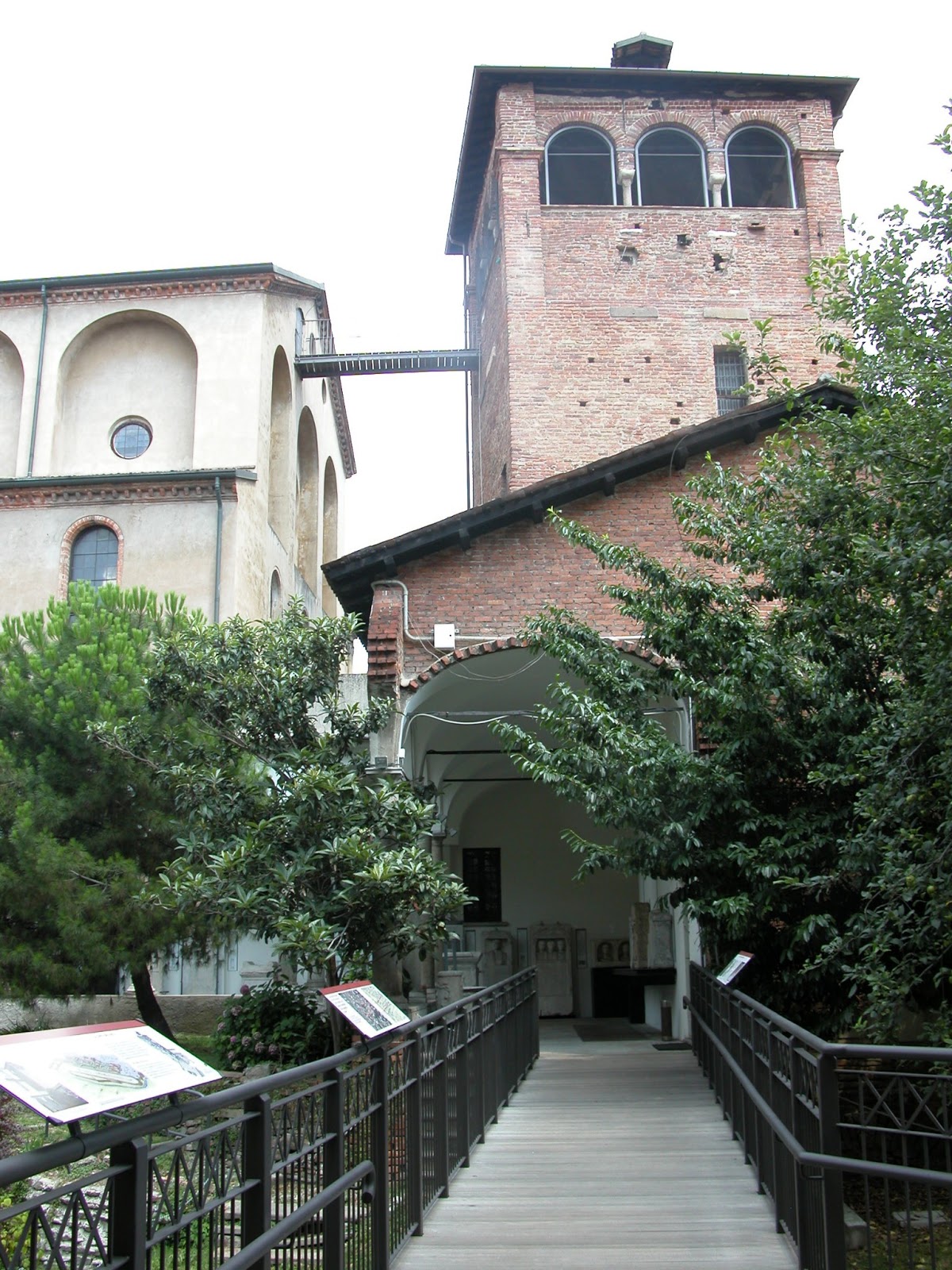
Next, head out into the courtyard. Just in front of the backside of the museum are the uncovered foundations of an ancient Roman home, built just outside the Republican city walls, then covered up for the creation of the imperial era circus.

Under the Renaissance portico are ancient Roman grave markers, some with quite touching messages. Turn the corner, and walk the short uncovered distance to...

...the imperial era multi-faceted defensive wall tower.

In it was created a chapel for the nuns during the Medieval period. The restored frescoes are finally open to the public.

Back outside the chapel, continue on through the opening in the ancient walls and into the 'new' museum display areas opened up on three floors of an adjacent building, yeah! Each of the floors has been designed wisely with a glass seating area to admire the multi-faceted tower and...

...the square tower of the 'carceres' of the ancient Roman circus. The tower was reputedly repaired and turned into a bell tower by bishop Ansperto (869-881)--also responsible for adding the closed courtyard onto Sant'Ambrogio--and so bears his name.

In the new structure, the collections have been divided into Greek, Etruscan and early medieval. It's rather hard to choose just one object to entice you to go for yourself, but I settled on this very rare, because wooden, Etruscan burial urn jar top from the 7th century B.C. Pretty amazing. What else is there to see? Beautiful majolica of all epochs, little tanagra figurines, theater masks, a few jewelry pieces and small jointed dolls, votive sculptures, burial urns, sculptures, swords and helmets, and three scientifically reconstructed early medieval likenesses created and dressed in life-size (those are a bit eery, but might be particularly fun for the kids). There even are a very few Egyptian things; most of this collection is in the Egyptian museum in the Sforza Castle. (Want a sneak peek at the Egyptian museum at the Sforza Castle? See my post about a rainy day in May.)

Before leaving the museum, the ground floor has a bookshop enlarged when the museum was renovated. There are only a couple of postcards, though (boo-hoo!).

Well, well, well, that's about it, right?

Wrong!

They've wisely re-opened a door (hard to the left, just after entering the museum) between the structure now housing the museum and the early 16th century church of S. Maurizio completely carpeted with gorgeous frescoes dating mostly up to the third quarter of the 16th century...quite an eyeful not to be missed...but a whole other post for another day. Access to the church is available directly from the street, too, but you'll have to climb up a few stairs (though, come to think of it, there might be a ramp instead of stairs connecting the museum and the nun's private area of the church, so, if you're in a wheelchair, you might be able to see at least that).

Access to the museum is a bit more handicapped-friendly. There are elevators for those not willing, or able, to do the stairs in the two main structures of the museum. On the back of the museum is a small moveable platform for lifting wheelchairs up the half dozen steps to get visitors up to the ground floor. Please contact the museum ahead of time to make arrangements...you'll probably have to find someone to help you talk in Italian: tel. 02.88465720, fax 02 88465721. If you don't know anyone who speaks Italian, try showing up with a picture of the wheelchair to send into the museum with someone able to do the half-dozen stairs at the principal entry on Corso Magenta, 15, not far from bus stops for the 16 and 27 lines.

Once you've finished, if you'd like to snoop into the nun's larger Renaissance courtyard, you'll have to do it from the street, right across via Luini (opened in the late 19th century) from the side flank of the church. It's rather plain, but interesting, nonetheless.

Archaeological Museum at Corso Magenta 15 (near stops for lines 16 and 27 of the tram; open 9 A.M. to 5:30 P.M., every day except Monday and certain public holidays).

So, with this celebratory platter dedicated to Cybele coming from nearby Parabiago and dating touchingly to the last breaths of paganism in the late 4th century A.D., it's time to say goodbye to the Archaeological Museum of Milan, I hope I've sparked your interest, it's truly worth a few hours.

Want more info about ancient Roman Milan? See my post wishing happy birthday to Rome.

Enjoy!

Monday, July 15, 2013

Sempione on a Sunny Sunday

"Gotta get out and walk, it's too nice to stay inside all day" actually turned into a walk thanks to my camera. First, down Corso Sempione to the park. Bit of morning haze. Hot, a little humid, but--if in the shade--quite nice....More......


At the northern end, the park begins with the "Arco della Pace" (The Arch of Peace) whose flip-flop tale expresses recent Milanese and Italian history. By the architect Luigi Cagnola, its construction began in 1807 to honor Napoleon and his victories, and the arch is aligned with the back portal of the Sforza Castle on a purposefully straight shot to Paris. The construction had gotten as far as the tops of the side arches by 1807, and then stalled. Work began, again, in 1827, but this time encouraged by the emperor of Austria, under whose sway Italy returned after the 1815 downfall (hoped to bring peace, hence the arch's name) of Bonaparte. The arch was finished by Cagnola, and the two side buildings were added, in time for the emperor's coronation as King of Lombardy-Veneto in September of 1838. The inscription extolling the Austrian emperors--no surprises, here--was taken down, and replaced with an inscription consonant with Milan's liberty won in 1859.

A few minutes walk into the park, and here's a hint of things to come: a modern sculpture called "Chiosco sculpture" (Kiosk Sculpture) by Roccamonte, sponsored by an Italian company of cement-makers in 1973. Needs a good cleaning, though. I found the company online, and have sent their PR office an e-mail. Let's see if it does any good.

Nearby are the Torre Branca (the Branca brand of alcoholic beverages sponsored the restoration, so why not rename the tower after them?; after all, it had languished nameless since the downfall of Fascism, and the fall in disgrace of its original name: Torre Littoria), where you can pay a few Euros and go up to the top for a panoramic view, and the Triennale (here's a view from the backside). Built in 1931-33, thanks to the generous donation of an industrialist, as a permanent seat for international expositions of decorative arts (i.e., art + industry), the building still focusses on what now is called "design," and often has interesting exhibitions. More about those in another post.

For now, a glimpse of just one of the pieces of modern sculpture in its enclosed back yard: de Chirico's "Bagni misteriosi" (Mysterious baths, in the sense of dipping one's body into water, not bathing for cleanliness).

The pond and the seemingly natural growth of trees in the park with its winding paths expresses the 19th century fashion for this English-style of landscape gardening. The park, replacing the castello's large semi-wild "barcho," where the Visconti and Sforza dukes and court conducted the princely pastime of hunting, was planned as early as Milan's independence (remember that 1859 date?!), but financial problems kept anything from happening until Emilio Alemagna's 1893 plan was finally executed (P.S., he also was responsible for the current state of the public park in Porta Venezia).

Just about in the center of the park is the much beloved Siren bridge. Originally built in 1842 over the corner of what are now Via Senato and Corso di Porta Venezia, they were moved here when the canal was covered up. (Boo-hoo! Let's reopen the canals!)

If you've got your eyes open, you might run across this little fountain set up in 1928. The signs say "Acqua marcia" (Spoiled water) and "non potabile" (not drinkable), but...the water coming from a natural well and stinking of rotten eggs thanks to the natural sulfur content is still prized by some as 'good for you.' (blech)

Ever heard of Damnatio memoriae? Here's a good example. Napoleon III was a hero in the peninsula for his decisive aid in helping the Milanese (and, hence, the rest of Austrian-dominated Italy) liberate themselves from the emperor. Happy as clams, the Milanese commissioned this life-sized towering sculpture and base in 1881 from a leading sculptor of the day, Barzaghi, to commemorate him. It was to go in one of the city's principal piazzas. So, what's the problem? Napoleon III shifted allegiances according to his conscience during the long war for independence. As long as the Milanese wanted to free themselves from his rivals the Austrians, it suited him just fine, but when they turned on the papacy (1870) to liberate great swathes of the peninsula from the pope's terrestrial power, that was another thing, entirely, so he jumped to the aid of the pope. Naturally, that didn't make the Milanese very happy, so fighting between those grateful and resentful shunted the sculpture first to the closed courtyard of the ex-Senate, and then tucked away amongst the trees in this area not far from the Siren's bridge.

Just behind the sculpture is a delightful little public library by Parisi and Longhi (1954).

Near to these both is the Arena, constructed in 1806 by the architect Luigi Canonica who also used material from the partial demolition of the Sforza Castle during the brief Napoleonic period of independence. It can hold 33,000 spectators, and still is used, today...though I haven't been inside, yet. Will have to remedy that.

Near the Arena is the Acquarium. Built by Sebastiano Giuseppe Locati and decorated with colorful naturalistically themed ceramic tiles by the firm Richard Ginori for the 1906 Expo in Milan and reconstructed after WWII, it was restored in 2006. Small, but delightful. There also is a tunnel tank to walk under. Fun for all the family. Note, too, the handicapped ramp.

This gives me the opportunity to mention that, in general, Italy is not equipped for those in wheelchairs. At all. You might have a corner, or two, with handicapped ramps, then the subsequent ones don't, or, if they do, have been created just after a traffic light or sign pole that squeezes access. Buildings, even those from just before and after the war, either don't have elevators, or, if they do, the elevators don't go to the ground floor (those crazy architects...thinking more about 'gentility' of style than practicality). There's almost always two, three or ten stairs to go up before an elevator can be reached. Then there's the thorny question of historic buildings. Should, or even CAN, the historic structure be cut and modified to add elevators? It's a question without an easy answer, but here at the Acquarium, it already has been solved. (Before someone writes in the comments about politically-correct language, I personally think this is one of the instances where it has gone overboard. "Disabled" sounds like a machine whose functioning has been destroyed. Much better to de-stigmatize the word already in use. That's my two cents' worth.)

Pretty close is a kiddy park with merry-go-rounds and bumper cars for the wee ones. It was lovely to see families not just at the mini-amusement park, but scattered throughout the park, just sitting on the grass and enjoying each others' company. Lots of dogs with their owners, too. There are fenced in areas to let dogs run free. Legally, dogs are not supposed to be off their leashes unless they are in these areas, but when did that ever stop Italians?! They're finally learning to pick up dog poop, though, and that's a plus.

Don't be afraid to go for fear of thirst and potties. There are port-a-potties throughout the park (though I can't say what state they're in) and public fountains, called "vedovelle" (little widows, because they are constantly "weeping") throughout the park and the city. The water is not just safe to drink, it's also good. For those of you new to town, you don't have to break your back bending down to drink out of the gush from the little dragon's mouth. Look on the top of his head. If there's a little hole (and there should be one), stop up the dragon's mouth, and the water spurts up out of his head.

Heading back in the direction of the Sforza Castle, I passed this odd thing in construction. It will be called the "Chiosco Conti" according to the posted info. The kiosk part I get, but that weird giant hand? Oh well. It will be easy to remember for rendezvous'.

Here, it's shortly after noon, and you can see that the morning's haze has burned off, the sky is a gorgeous blue, and the sun was very very hot. The parks here and behind the church of San Lorenzo were fenced I'm guessing about 10 years ago, and it has made an enormous difference in public safety. They're shut every evening, and opened, again, in the morning. Nevertheless, Parco Sempione also has SOS phone kiosks scattered throughout. Does this make you think twice about going? No, it shouldn't, at least in the more trafficked areas, and when there are lots of other people around. A bit of common sense--especially for us ladies--goes a long way.

A walk through the Sforza Castle took me to the tram stop.

This tram line uses the historic one-car trams built in 1928, and refurbished after WWII. Love the warm honey-colored wood. (Some of the historic trams were sold to San Francisco, where they became trolleys!)

The effortless beauty and sophistication of some Italian ladies is lovely to behold (and causes a bit of envy).

It was a lovely long walk of about two hours. I hope you enjoyed it, too!

Friday, July 12, 2013

Calling all Hitchcock fans...it's not too late!

There are still some days left in the Hitchcock series (in English!) at the Spazio Oberdan theater!...More......


The films are shown in English with Italian subtitles. (Hint to movie-makers: Though the need for native language subtitles is obvious, English subtitles are better for learning English.)

Films on the 12th (today!), 13th, 14th and 17th are shown at various afternoon and evening times.

The list with the titles and show times on the Italian-only web site is in Italian, and there is no indication of the original title in English. Click on the links, anyway, to see the pictures; you'll probably recognize the films from those.

Place: Spazio Oberdan, Viale Vittorio Veneto, 2 (corner of Piazza Oberdan, MM1 Porta Venezia)

Cost: E. 8 (for Spazio Oberdan cardholders: E. 6.50)

Enjoy!

Thursday, July 11, 2013

"So far, so close" at the 'House of [various] Cultures'

Love exploring other cultures without the bother of travel? Here's an opportunity for you: "So far, so close," an exhibit of contemporary international art at the "Casa delle Culture del Mondo" (The House of [various] Cultures of the World), until July 17....More......

La Casa delle Culture del Mondo
Via Giulio Natta, 11
MM1 Lampugnano
Tuesday - Friday, 10 A.M. to 6:30 P.M.
Saturday - Sunday, 2 P.M. to 8 P.M.
Closed Mondays

Interested? Better hurry! The "House" is closed for the summer from July 22 to September 9.

Oh, and why did I insert "[various]" into the English translation of the name of the gallery?

You tell me!

Want a hint? It has to do with the rules of English.

Enjoy!

Tuesday, July 2, 2013

Hitchcock in Milan...in English! 1 - 17 July 2013, Cinema Spazio Oberdan

Bird brains! If you look verrrrrrry closely at the background, you'll see the watchful cat behind these wary pidgeons. Not quite the savage crows of Hitchcock's "Birds," but the best that I could do....More......

Love Hitchcock? Want to practice your English? You're in luck! At the small Cinema Spazio Oberdan in Piazza Oberdan, where they show artsy and artistic movies, you'll be able to enjoy the master of suspense in his mother tongue from the 1st of July to the 17th, all in preparation for the September show dedicated to him at the Palazzo Reale in September. All 8 masterpieces to be shown were produced between the 1920s and 1940 (when H. went to Hollywood), and will be in English with Italian subtitles.

Address
Viale Vittorio Veneto, 2
corner of piazza Oberdan, Milano

MM1 Porta Venezia
Telefone ticket office: 02 7740 6316
Telefone office: 02 8724 2114

Entrance fee: € 7,00

Reduced entrance fee for those with the Cinetessera card: € 5,50

Entrance fees for movies shown at 3 P.M. and 5 P.M. on weekdays: full entrance fee € 5,50; reduced entrance fee for those with the Cinetessera card: € 3,50

Annual Cinetessera card: € 5,00 (also valid for movies shown at MIC and the Area Metropolis 2.0 of Paderno Dugnano)

Tickets may be acquired up to a week before the showing at the Spazio Oberdan during regular ticket office hours.

More info (including the line-up of titles) here...but in Italian.

Enjoy!

P.S., I snapped the picture on June 1, 2013, at 5:45 P.M. behind S. Pietro in Gessate also for your personal non-commercial enjoyment.
Related Posts Plugin for WordPress, Blogger...