Showing posts with label Quarter-La Scala. Show all posts

Friday, May 16, 2014

Google, Maria Gaetana Agnesi and via Manzoni 6

Maria Gaetana Agnesi, a Milanese woman born into a well-to-do family in 1718, dedicated her life first to scientific and humanistic learning of the highest levels, and then to caring for the poor for which she spent even the last pennies of her hefty inheritance, and gave up the family mansion to live in a humble suite of the Pio Albergo Trivulzio, of which she had been nominated director. She died in 1799, and was remembered two decades later in the bust on the far right on the façade of the Brentano-Greppi mansion at via Manzoni, 6. For more info about her and the palazzo, see my earlier post.

Today, she is honored by Google with a lovely animated logo, catch it while you can.

I snapped this photo on the 2nd of August, 2011, around 3:30-4 PM.

Enjoy!

Tuesday, October 4, 2011

Calling all shoppers! A new (and very nice) brand name outlet in Milan

Love to shop? Love to get a good bargain?

You're in luck! There's a new discount brand outlet in downtown Milan.
...More...

START UP FASHION DEMOCRACY, via Omenoni, 2, tel. +39.02.8909.3683

Don't be confused by their address on via Omenoni. Even their so-called handy dandy map on the back of their handout is wrong (come on, guys...where's the editorial control?). Maybe it's their legal address. That's possible.

The entrance, in any case, is under the portico on Piazza Meda, at the part where the piazza narrows to a point behind the church of San Fedele in the direction of Piazza della Scala.

On the ground floor (there's a step, though, so it's not very wheelchair accessible...lots of progress still to be made on this front in Italy) are things for women and men, I saw an upper area too packed with shoe boxes to be available for browsing, maybe they'll bring them down for you. More men's things are up another set of stairs, while things (lots!) for tots and for the house are downstairs (there is an elevator for that part of the store).

Lovely lovely LOVELY house things of the sort perfect for one's own home, or gifts.

Most of the discounts are up to 50%, according to their advertising, but I also saw a cheery knit throw for 70% off. Beautiful, and only about E. 35 (what's that...about $42 or $45?). (If you haven't indulged in this luxury, yet, run to do it! There's almost nothing so cozy as a knit blanket that keeps you warm, and snuggles up, and stretches comfortably to fit you while you're lounging on the couch, or bed.)

For other discount shopping tips, look up the category/label "Shopping" in the right hand column.

Enjoy!

Tuesday, August 2, 2011

Bookworms, epigraphy and the luck of the (non) Irish

Us bookworms get excited about the oddest things, I admit. But let's leave that aside, for the moment, and let me set the stage, properly....More......

The fearful self-isolation then death (1447) of the last legitimate duke of Milan, Filippo Maria Visconti, followed by bloody settlings of old festering wounds, bursts of rage, backstage back-stabbings, burning archives (oddly, the tax records, too...), the ducal castle-fortress (useful to defend the city against invaders, but also to defend the dukes against the citizens) half torn down, a couple of years of brilliant hopes for citizens' self-government (well, the male, free, white and empowered, although not noble, but that's already a step ahead), then trembling and anguish at the prospect of getting gobbled up by feared powers-that-be. Appearing on the horizon, literally in shining armor, whom do we have? Good ol' Frank.

Francesco Sforza, expert general-for-hire (ahem, they're politely called "condottieri"), who just happens to be married to Bianca Visconti, the young and lovely bastard-but-legitimized-by-the-pope daughter and only direct heir (but not to overt power, no, no, no, Salic Law, you know) of dear deceased Filippo.

"I'll save you!," says Francesco. (He did.)

"I won't rebuild the castle-fortress!" (He did, actually, but had his imported fancy-pants architect, Filarete, beautify it a bit in the new Florentine Renaissance style to soften the blow.)

"In exchange, I'll be the duke!" (He wasn't...legally...one of his sons finally pulled that off a couple of decades and tons o' money to the Holy Roman Emperor, later, but it's just a piece of paper, right?)

And one of his right hand men was Gaspare Vimercati, whom you also have to thank for Santa Maria delle Grazie (where, about fifty years later, Leonardo da Vinci painted The Last Supper), another condottiere, and the proud new owner--after it had been confiscated by Sforza from its original owners (evidently of the Taverna and Secco d'Aragona families, as the family crests flanking the door attest)--of the house on the street, where the first ring of ancient Roman walls had gone, long before: via Filodrammatici, n. 1.

The gorgeous doorway from that mid-15th century period opens this message. The pointed arch and the florets help mark it as Gothic. The chubby putti climbing whimsically up the acanthus leaves along its profile could be seen as a concession to the new Florentine style and/or as Gothic, yes, Gothic...there was quite a strain of naturalism running through the Gothic style, believe it, or not.

And, luck of the (non) Irish, it has been cleaned, recently, yeah! (It was so black with accumulated grime and soot that those old photos of mine aren't even worth hunting up.)

So that's already a jump for joy.

What really made this little bookworm happy is that the photos I snapped of the epigraphy (the carved writing) came out really really well, double yeah! Francesco is flanked by and towers over...
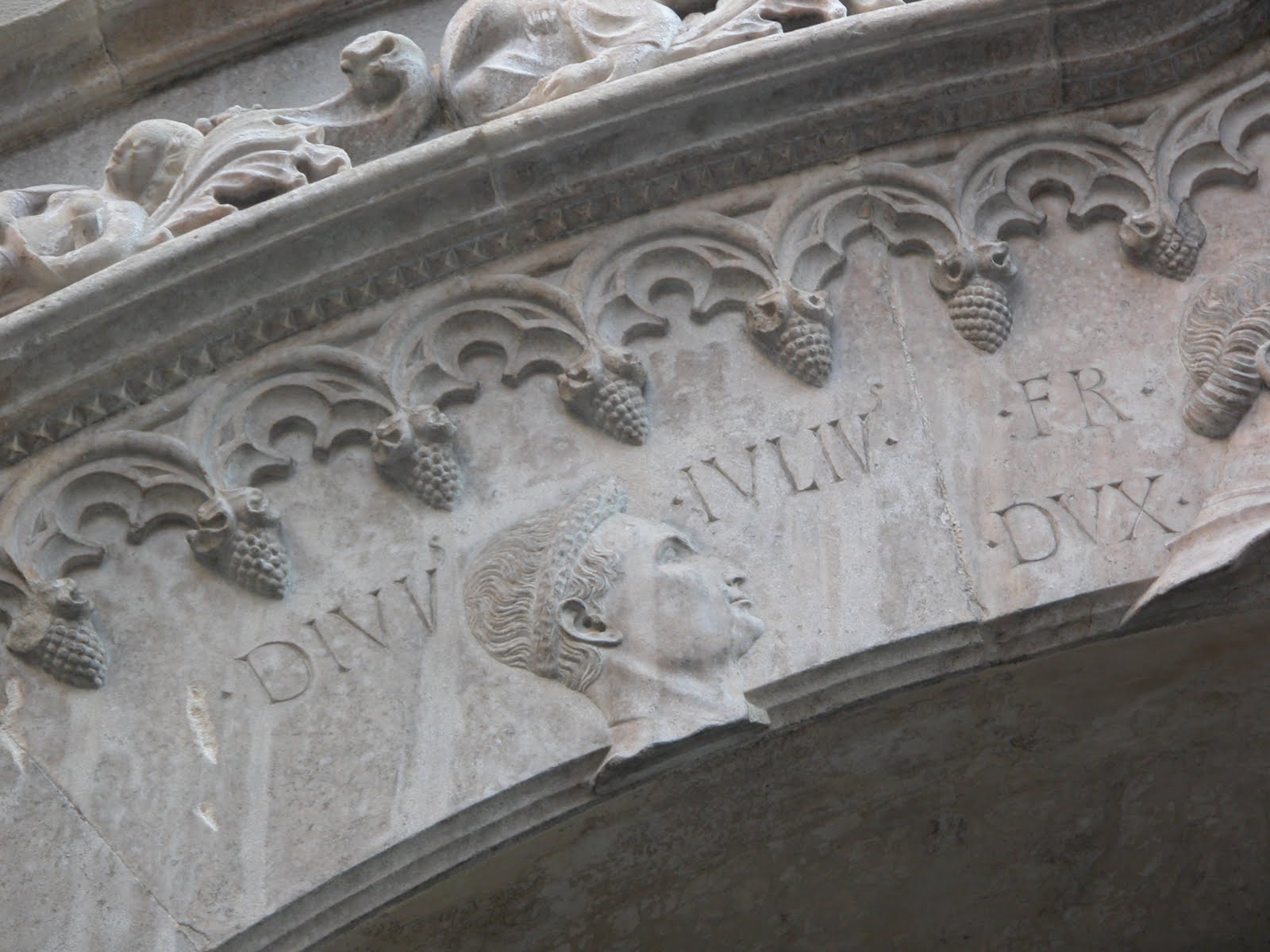


...Julius Caesar on the viewer's left and...


...Alexander the Great on the viewer's right (no boot-licking going on here, nope, nope).


Above it all, the pinnacle with the motto - SITE - FATA - VOCANT -...and for anyone familiar with epigraphy, you'll see change in the making...tall and slender straight V-cuts with abruptly stuck on serifs, sharply squeezed "Os", a tilted bar to the "As" and "N" and little diamond, or triangular, interpuncts at mid-line. Looking forward to the Renaissance revival of Imperial style lettering, but with a wistful backward glance to the Gothic style much beloved in Milan, cross-roads between north and south of the Alps.

Oh, the things that get our little bookworm hearts a-pumping!

Tuesday, March 8, 2011

Happy International Women's Day from Milan, Italy


Experiences--painful, dispiriting, enriching, joyous--lived and to be lived. The request? It's not so hard to understand, and shouldn't be so hard to do: equality respecting differences.

I shot this snap with you in mind at the corner of Via Santa Margherita and Piazza della Scala the 29th of December, 2010, at about 4:15 P.M.

Thursday, December 30, 2010

Whirlwind gorgeous afternoon (it's a long one: forewarned is forearmed)

Thwarted in my afternoon’s bureaucratic errand (they won the battle, but not the war! another skirmish is planned for tomorrow!), with about an hour to kill before another appointment, and favored by the return of cold, but clear, weather, I whipped out my beloved camera, and snapped away happily and so successfully—at least I think so!—that it’s hard to choose just which one, or two, to share, so here’s a whirlwind tour starting in Piazza Cordusio and ending behind the Duomo...More......

As we rev up the engines ready for the sprint, I’m sure you all will remember a hint I’ve dropped in previous posts: swathes of style also are indicators of bursts of personal and civic wealth, and here’s an excellent example, the Eclectic style building by Luigi Broggi for the bank Credito Italiano in 1901, a handful of years after recovery from a fierce nation-wide financial crisis (1880-1883; after changing hands, the building now houses UniCredit). What better way to boast of financial solidity and stability than to plant a sturdy elaborate building on one of the city’s central piazzas, surrounded by other banks and right across the piazza from the city’s first modern stock exchange (now hosting post office functions)?

Behind the façade, the building later was united by the architect Giovanni Muzio with the flanking one in via Tommaso Grossi, also by Luigi Broggi, which, besides being a delightful example of Milanese Art Nouveau (called “Liberty,” after the name of the London store from which goods in that style arrived in Milan), expresses an important development in modern architecture seen also in France. Constructed in 1901-03 to store the Contratti family's business goods (which included enameled objets d’art), it is an “in-your-face” use of what before had been considered low class materials suitable only as structural, not external and decorative, elements: cast iron and reinforced cement. (There are two other nearby examples on via Spadari and Corso Vittorio Emanuele.)

I ask you: how can architects and clients be so insensitive to the surrounding buildings to tack something so horrible onto such a delightful little building, even if considered “dated” at the time?! No news about it in my handy dandy “Milano” by TCI-Touring Club Italiano, the source for my info in this post. May the architect’s name come to light, so it can be covered in shame.

Onward and upward to a possible art historical scoop! The light finally was right to capture the façade of this delightful structure on via S. Margherita (…get ready for this, folks, it runs over the original “cardo massimo” of the ancient Roman version of Milan, no kidding!!!) probably from the 1930s built for the Banca di Sicilia. Couldn’t find any info about it in my usually resourceful TCI “Milano”. How disappointing. The pictures came out great, though, and luck was with me, my hand was steady enough for close-ups of the four principle relief sculptures. May I have a drum roll, please?

Under the second figure from the right, a female figure carrying a sheaf of wheat, the sculptor’s name is clearly visible: GIGI SUPINI F. (the “F.” is for “FECIT,” Latin for “did/made it”). Since it’s so late, libraries are closed, and I’m so lazy busy, anyway, I hunted about on the internet for some reliable information about him. Didn’t find much, but did find out that he also was responsible for the relief sculptures on the “Toro” building on Piazza S. Babila, so he was no small pickings. Calling all art and architectural historians, remember to cite me, when you note this in your next best seller!

A hop down via S. Margherita, and we arrive at Piazza della Scala, with two more examples of post 1880-83 economic fiasco bravado: the Banca Commericale Italiana (1905-1911) by Luca Beltrami and …

… his façade (1886) on what was originally the unfinished back side of Palazzo Marino, a fascinating story in and of itself (this self-aggrandizing and literally bankrupting project for Marino, a transplanted banker from Genova, was begun by the top notch architect Alessi in 1553, and the original façade—Beltrami’s inspiration—on piazza S. Fedele was completed by 1572). It’s also a great shot of one of Milan’s 1920s trams, for you public transportation fans.

The bizarre public “art” currently sprinkled around town does include this illuminated swing in front of S. Fedele. What it has to do with Palazzo Marino, S. Fedele, or even Milan, is anyone’s guess, as is the case with lots of this Christmas’s equally surreal decoration. At least the swing is entertaining. I mentioned the church, begun for the Gesuits by Pellegrino Tibaldi in 1569, in an earlier post, when talking about the monument dedicated to Manzoni.

We’re on the home stretch, folks! Here is via S. Radegonda, not very inspiring, a bit narrow and claustrophobic, but the store “Rinascente” has constructed a fun neon bridge connecting their original structure to its adjunct, and the street is profoundly important for Milan’s history: Piermarini, the favorite architect in Milan of the Austrian Hapsburgs (a lot of northern Italy was part of their humongous empire), snapped his fingers in 1783, and down went an ancient Benedictine monastery and hospital dedicated to that saint, and up went a street. Less than twenty years later (1801) up went a theater. Almost exactly a century later (1882), Thomas Alva Edison snapped his fingers, and in the shell of the ex-theater up went Europe’s first thermal plant for the generation of electricity; business boomed with the upswing in industrial activity, and plants popped up like mushrooms all over northern Italy. In 1923, Edison bought and transferred its offices to an 1892 building on Foro Bonaparte.

Since the Odeon cinema was created by Giuseppe Laveni and Aldo Avati in the general area also in 1923, I’m halfway remembering that I read somewhere that the building is one and the same. Take it with a grain of salt.


What would a post be without taxis, lately? Here’s the taxi stand in Piazza Fontana, created by Piermarini in the late 18th century between two late 16th century witnesses of continuing Milanese importance: the Archbishop’s palace (at our backs in this photo) and the captain of justice’s building begun in 1578 by P.A. Barca (just barely visible in the back left), which figures in Manzoni’s “Promessi Sposi” for you Italian literature fans. Piermarini’s favorite sculptor, Giuseppe Franchi, translated his design into reality for the fountain (1782). Who was responsible for this year’s public “art” and the horrible Christmas lighting covering the fountain (thankfully, not very visible during the day) and…

…these horrible things, like multiple Daphne’s on acid? I need to remember to pass by, and look for a plaque with information about the ‘artist.’


Time to quit this rush, so I’ll close with the clock added in 1865 by Giuseppe Vandoni to the cornice of Pietro Pestagalli’s 1841 building in the area behind the Duomo, over the area known as the “campo santo,” or “holy ground,” which all over Italy served as a work yard for churches in construction and as a cemetery.

After these last photos, I headed a skip away to a delightful afternoon of tea (and, ahem, a couple of cookies) with two lovely ladies.

My hands were frozen stiff, despite the gloves, and I hope I haven’t worn you out!

I took these photos on December 29, 2010, from about 3 P.M. to 4 P.M.

For a great blog on taxi driving in New York City, see: http://www.nyctaxiphoto.com/

Monday, October 25, 2010

Snarl, cont. (a lion on San Fedele, Milan)


Yesterday's snarl disappeared almost as fast as it burst out, but lions are so much fun, here's another one!...More......

This one is up quite high on the left hand flank of San Fedele, a little late 16th century jewel of a church more known, today, probably because on its steps the elderly Manzoni, one of Italy's most important writers, slipped, fell, banged his head and shortly thereafter died.


His figure is commemorated in a sculpture in the piazza in front of the church.

The church also is remembered, today, because, in the furor following Napoleon's downfall in 1814, his Milanese tax minister, Giuseppe Prina, was dumped out of an upper-storey window in his palace facing onto the courtyard in front of that church.

Inside, there's an interesting mix of Early Renaissance (tucked away...you'll have to hunt), late Renaissance and modern.

Personally, the location is just as fascinating.

The space where San Fedele is, today, was part of the area once in control of the Della Torre family, which had the bad fortune to lose the early 14th century power struggle with the subsequently ducal Visconti. Their houses were razed (hence the nearby street name "case rotte" / "ruined houses," an excellent example of how past monuments and happenings are remembered all over Milan).

What went up in their place?

The area also was part of the Santa Maria della Scala complex. Name ring a bell? It should.

The La Scala opera house got its name from the late 14th century church, built in this area by Beatrice Regina of the important Veronese della Scala family and wife of (intriguing) Bernabò Visconti (more about him in a future post) upon whose grounds, in turn, the theater was constructed in the late 18th century (alas, Mozart had stayed in Milan just a handful of years earlier, so he never got to see, or perform in, the new theater).

I snapped this photograph on the 7th of August, 2010, at 5:30 P.M.

To see the needlepoint design that I created out of the lion photo, see my needlepoint blog: Ars acupicturae stellae - Star's Needlepoint Art, http://arsacupicturaestellae.blogspot.com/2010/10/milan-monday-12-another-lion.html

Enjoy!
Related Posts Plugin for WordPress, Blogger...